Buying a Used RV in Florida: What to Look for Before You Commit
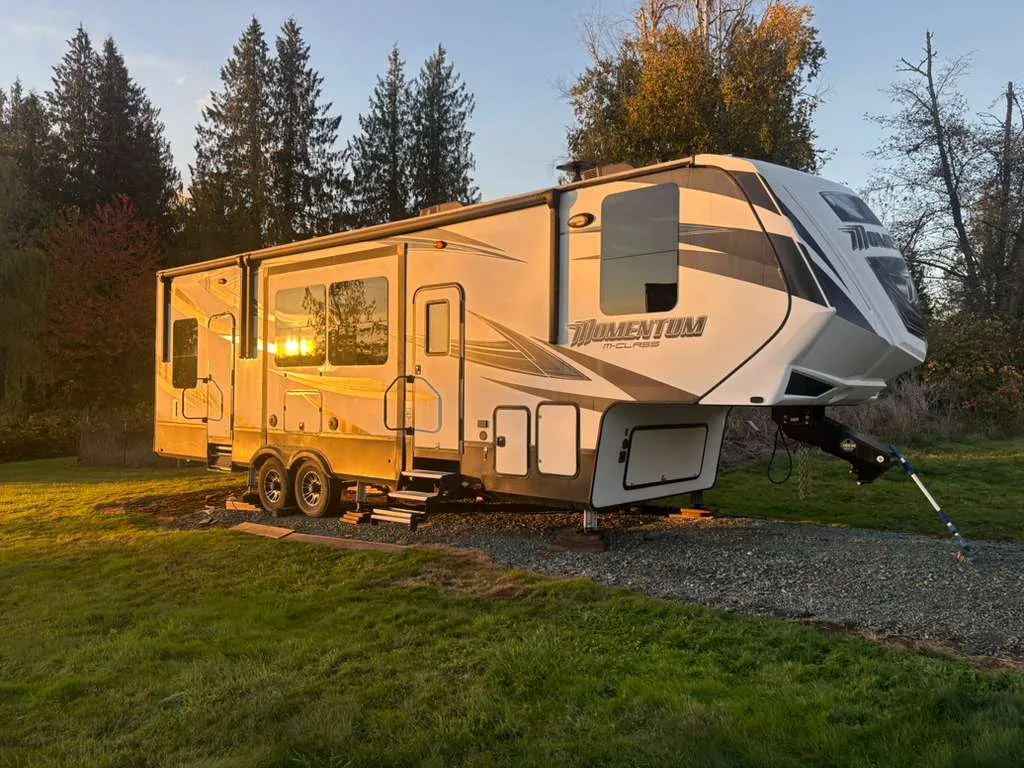
Florida used RVs have three risks that buyers from colder climates frequently miss: water damage from roof seals that fail in UV exposure, AC systems that have run hard and been poorly maintained in the heat, and slide-out seals that have been degraded by the same UV that affects everything else on the exterior. Finding all three takes about twenty minutes with the right approach.
Why Florida used RVs have a specific risk profile
Because the conditions that RVs face in Florida - year-round UV intensity, near-daily summer rain, high humidity, and salt air on coastal coaches - accelerate specific types of wear that do not appear at the same rate in dryer, cooler climates.
A coach that spent ten years in the Midwest has typically had its roof sealed once every few years, its AC unit running three months per year, and its exterior seals degrading slowly in lower UV. The same coach in Florida for ten years has had its roof seals cycling through expansion and contraction every day, its AC unit running eight months per year, and its exterior seals seeing UV levels that degrade rubber twice as fast.
This does not mean Florida coaches are bad purchases. It means the inspection priorities are different, and a coach with a documented maintenance history in Florida is more trustworthy than one without it, because the maintenance that prevents Florida-specific failures is ongoing and traceable.
A coach with no service records in Florida should be priced as if those systems need attention, because the probability that they do is high.
What does the roof condition tell you about the price?
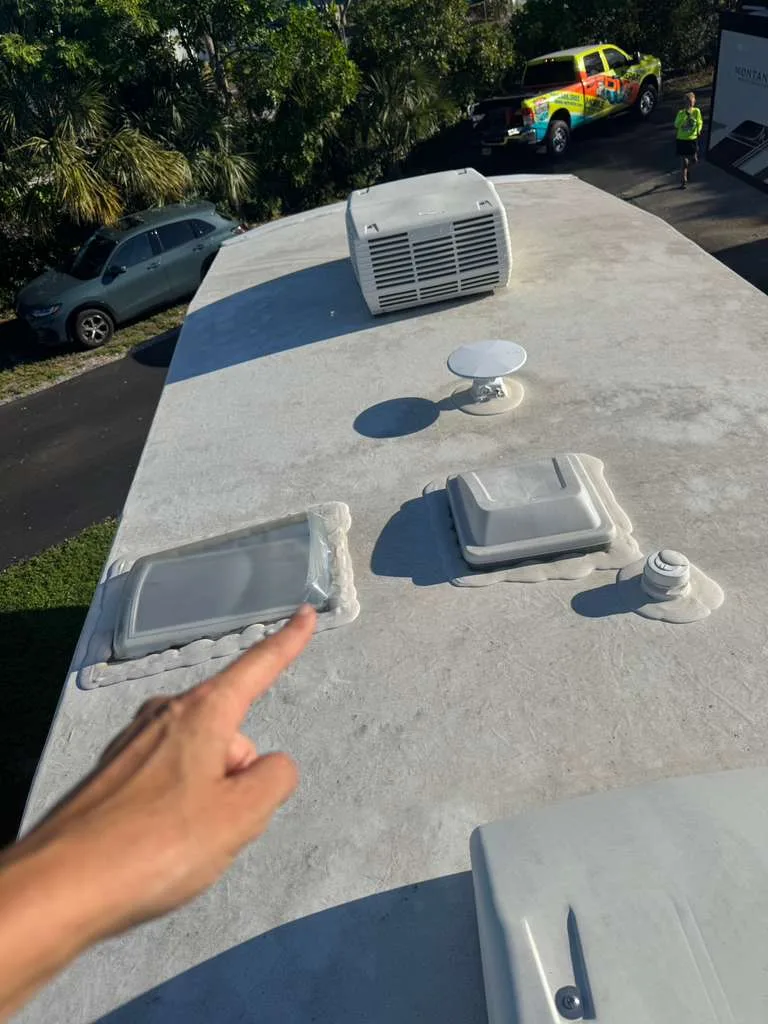
More than any other single inspection. A roof that is clean, has fresh sealant around all penetrations, and shows no soft spots when walked is a coach that has been maintained. A roof that has cracked sealant, lifted edges at the vents, or visible soft spots underfoot has had water entry that may have reached the interior.
Get up there and walk it. The soft spots in a roof membrane feel like give underfoot and are located around penetrations and at the roof edge, which is where water pools and where the seals fail first. A soft spot that you feel through the roof membrane means the decking beneath is wet or delaminated.
Look at the sealant around every vent, every antenna, every AC unit, and the roof cap at the front and rear. Sealant that has pulled away from the fitting, cracked into separate pieces, or turned yellow and rigid is past its service life. Ask when it was last resealed and by whom. If the answer is vague or the paperwork does not show it, assume the sealant needs replacement.
A roof that clearly needs resealing should be priced into your offer. A roof with soft spots or interior staining below the penetrations is a different level of concern - it needs a water damage assessment before you can know what the repair involves.
How to check for water damage before you commit
Walk every room with your hand on the wall at window height and at floor level, pressing firmly. You are feeling for panels that give under pressure, which indicates absorbed moisture. Compare the feel of walls you know are structurally intact - typically the interior walls far from the windows and slideouts - to the perimeter walls. Any wall that feels noticeably softer at any point has been wet.
Press the floor around every slideout perimeter, every doorway, and the front cab area below the windshield. These are the entry points where water travels down from failed exterior seals. A floor that gives near these areas has had water in it.
Look at the ceiling in the first twelve inches from the exterior wall on every wall. Brown or yellow staining anywhere near a roof fitting, a vent, or the front or rear cap indicates water entry. A fresh paint or new ceiling panel in one small area of an older coach is a repair that hides a previous stain rather than fixes the source.
Smell the coach with the doors closed and the ventilation off. A musty smell that is present without any visible source means mold is active somewhere behind a panel. In a coach that has been cleaned for sale, an owner cannot eliminate the smell entirely if the source is still wet.
What to check on the AC before the walk-through ends
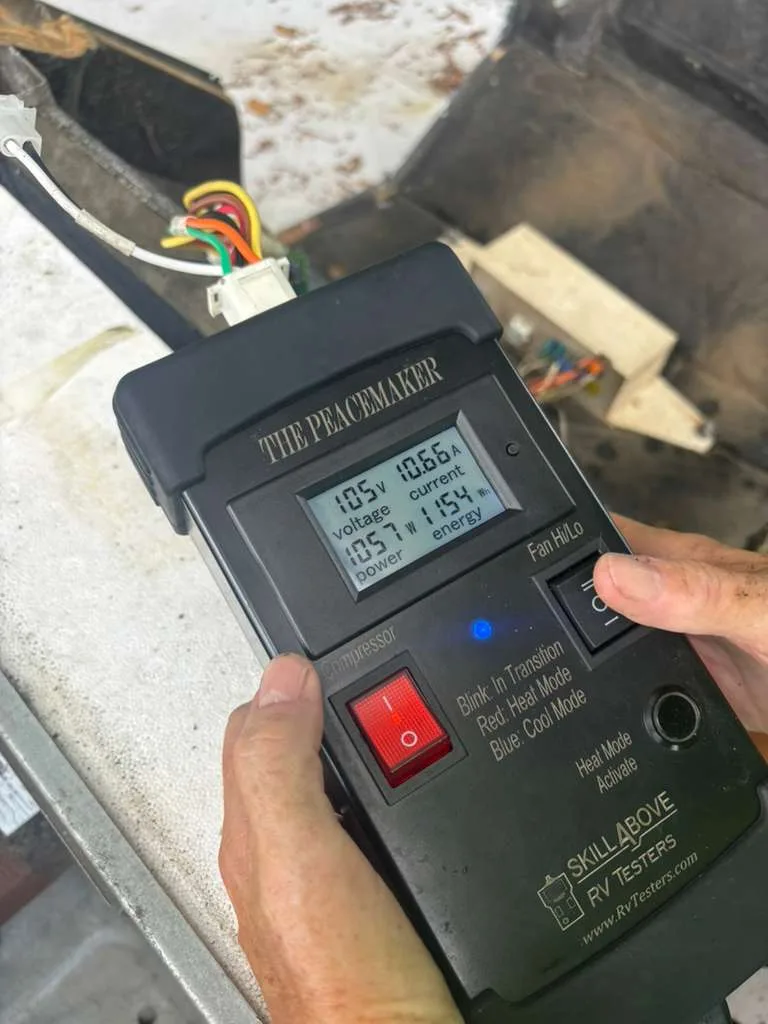
Run it. A Florida coach that has been used will have an AC unit that has run thousands of hours, and the way it runs tells you what it has left. Turn it on and give it ten minutes before drawing any conclusions.
Listen for the compressor kick in after the fan starts. A compressor that cycles on and off rapidly - short-cycling - is a unit that is low on refrigerant, has a failing capacitor, or is struggling with a partially clogged coil. Normal operation is a compressor that runs for several minutes at a time and produces a steady decrease in measured temperature.
Check the air temperature at the vent with a thermometer or your hand. A healthy unit producing a significant temperature split between the return air and the supply air is working. A unit that produces only slightly cooler air than it takes in is either low on refrigerant or has a blocked coil that is not transferring heat.
Ask for the service history on the AC unit specifically. An AC that has not had the coils cleaned in several Florida summers has reduced capacity from debris accumulation, which the owner may describe as 'the AC works fine' without knowing what full capacity actually feels like. A coil cleaning is a maintenance item, not a repair, but an unmaintained unit in its fifth Florida summer is nearing end of life.
Why the slide-out seals tell you more than the slide-out mechanism
Because the mechanism itself rarely fails without warning, but the seals degrade silently until they fail structurally, and a failed seal is both a water entry point and the source of slide-out stalls.
With the slide-out fully extended, run a finger along the bottom wiper seal on the outside where it presses against the slide-out frame. A healthy wiper seal is pliable, maintains its shape, and has no obvious cracks or tears. A wiper seal that is hard, cracked, or has lost its profile has been exposed to Florida UV without maintenance.
Retract the slide-out and inspect the perimeter where the slide-out meets the coach wall from inside. The inner seal should press evenly against the slide-out box around its full perimeter. Any gap, any area where the seal has pulled away, or any area where daylight is visible through a closed slide-out is a water entry point that has likely already produced moisture damage in the adjacent wall cavity.
Ask for the service history on the seals specifically. Slide-out wiper seals on a Florida coach should be conditioned annually and replaced every three to five years depending on UV exposure. A coach with no seal service records should be assumed to have seals at or past their service life.
What a coach that sat tells you about its electrical system
A coach that has been sitting for six months or more has a battery bank that has likely been discharged below the threshold for recovery, and potentially a converter that has run in float mode for so long that it has failed.
Check the house battery bank first. Connect to shore power and give the converter thirty minutes to charge, then check the battery voltage with a multimeter. A 12-volt AGM bank that has been properly maintained should read 12.7 volts or above after a charge cycle. A bank reading below 12.0 volts after thirty minutes on shore power has sulfated cells that will not accept a full charge.
Test every 12-volt circuit in the coach: all lights, the water pump, the slide-out controller, and the ventilation fan. A coach that sat without being run regularly may have corroded ground connections on any of these circuits, which show up as lights that flicker or loads that work intermittently.
The propane and refrigerator circuits are worth specific attention on a coach that sat. A propane regulator that was left open on a tank that ran out may have debris in the orifice. A refrigerator on a coach that sat closed through a Florida summer may have a colonized flue and a blocked burner tube even if it runs.
How to read the service history
Look for three things: roof sealant applications, AC coil cleanings, and slide-out seal service. These are the three maintenance items that matter most for Florida exposure, and a coach with documented service on all three at reasonable intervals has been owned by someone who understood what the climate requires.
A thick service file from a dealer is not automatically good news. Dealers service what fails rather than maintaining preventively, so a thick file may mean a coach that had problems addressed rather than one that was well maintained. Look at the dates and what was done - annual or biannual preventive maintenance records are more reassuring than a file full of one-off repairs.
Ask whether any insurance claims have been filed on the coach. A claim on a Florida coach is often for storm damage, water damage, or an awning event. The repair may have been done correctly, but knowing it happened tells you where to look most carefully during your inspection.
No service records is information too. A coach with no documented service history in Florida has either been maintained by an owner who did not keep records, or it has not been maintained. The inspection result is what tells you which, but going in with eyes open and a lower offer is the appropriate response to a file that does not exist.
When a pre-purchase inspection is worth the money
On any coach above a certain purchase price, the question is not whether a pre-purchase inspection is worth it - it is. A professional inspection typically costs several hundred dollars and takes two to three hours. The savings on a water damage repair that the inspection catches is typically several thousand dollars minimum, and a structural repair can be tens of thousands.
The inspection is most valuable when the coach has been lived in full-time, when it has been stored for an extended period, or when the service history is incomplete. All three conditions increase the probability that there is something the seller has not noticed or has not disclosed.
An NRVIA-certified inspector follows a defined inspection protocol that covers over a hundred items including the roof condition, the water damage indicators, the electrical systems, and the LP system. The report they produce is a document you can use to negotiate price, and it is the baseline condition record if the sale goes through.
Our pre-purchase inspection guide covers what the inspector checks in detail. Our water damage service is what typically follows when an inspection finds a problem that was not in the listing description.
Questions buyers ask about used RVs in Florida
Are Florida RVs a bad buy compared to RVs from drier climates?
Not if they have been maintained correctly. A Florida coach with documented roof sealing, AC service, and slide-out seal maintenance is a known quantity. A coach from a dry climate with no maintenance records may have problems that are harder to spot. The question to ask is not where it was, but how it was cared for.
What is the single most important thing to check on a used Florida RV?
The roof, both from above and from below. Water damage from a failed roof seal is the most expensive and most common issue on Florida used coaches, and it is the issue that is most reliably detected by physically getting on the roof and looking at every penetration seal and every square foot of membrane.
Should I buy from a dealer or a private seller?
Either can be a good purchase. Dealers typically offer a limited warranty and handle the title transfer process more simply. Private sellers often offer lower prices and sometimes have more detailed service history. In both cases, a pre-purchase inspection is the equalizer - it puts you in the same information position regardless of who is selling.
How much should I negotiate based on a pre-purchase inspection?
The inspector's report will itemize findings and some inspectors note approximate repair costs. Use the documented findings as a negotiating basis - the cost to address each item is a reasonable offset from the asking price. A seller who will not negotiate on documented inspection findings is a seller who already knows about the issues.
What year or age of RV should I avoid in Florida?
Age is less predictive than condition. A fifteen-year-old coach that was garaged and maintained is a better purchase than a five-year-old coach that was kept uncovered and never resealed. The EPDM roof membrane that most coaches use has a ten to fifteen year service life under normal conditions, and Florida UV accelerates that - a coach approaching that age without documented roof replacement deserves extra scrutiny.
Can I get a Carfax or vehicle history report on an RV?
Yes, using the VIN, and it is worth doing. Vehicle history reports for RVs show title changes, odometer readings at each title transfer, and any accidents that were reported to insurance. They do not show maintenance history or water damage unless there was a corresponding insurance claim. It is a starting point rather than a complete picture.
Sources
- National RV Inspectors Association - Standards for professional RV inspection and what a pre-purchase inspection covering Florida-specific conditions should include.
- US EPA - mold guidance - Mold establishment conditions relevant to evaluating water damage in a used RV that has been in Florida's humidity.
- Dometic - product support - Service documentation for AC units and refrigerators found in used RVs, including maintenance intervals and diagnostic information.
- US Department of Energy - Energy Saver - AC system efficiency and maintenance guidance relevant to evaluating whether a used RV AC unit has been serviced appropriately for Florida operating conditions.