Mobile RV Inverter and Power System Installation Across Florida
An inverter converts 12V battery power to 120V AC, letting you run appliances without shore power or a generator. The right size and type depends entirely on what you are trying to power - and the wiring matters as much as the inverter itself.
An inverter converts 12 volt battery power to 120 volt AC so you can run appliances when shore power and the generator are not available. Getting this right involves three decisions that are completely separate from each other: output type (modified sine or pure sine), wattage, and cable sizing. Every one of them matters, and an error in any one of them will make the whole installation behave as though the inverter itself is faulty.
Modified sine versus pure sine: why the output waveform is the first decision
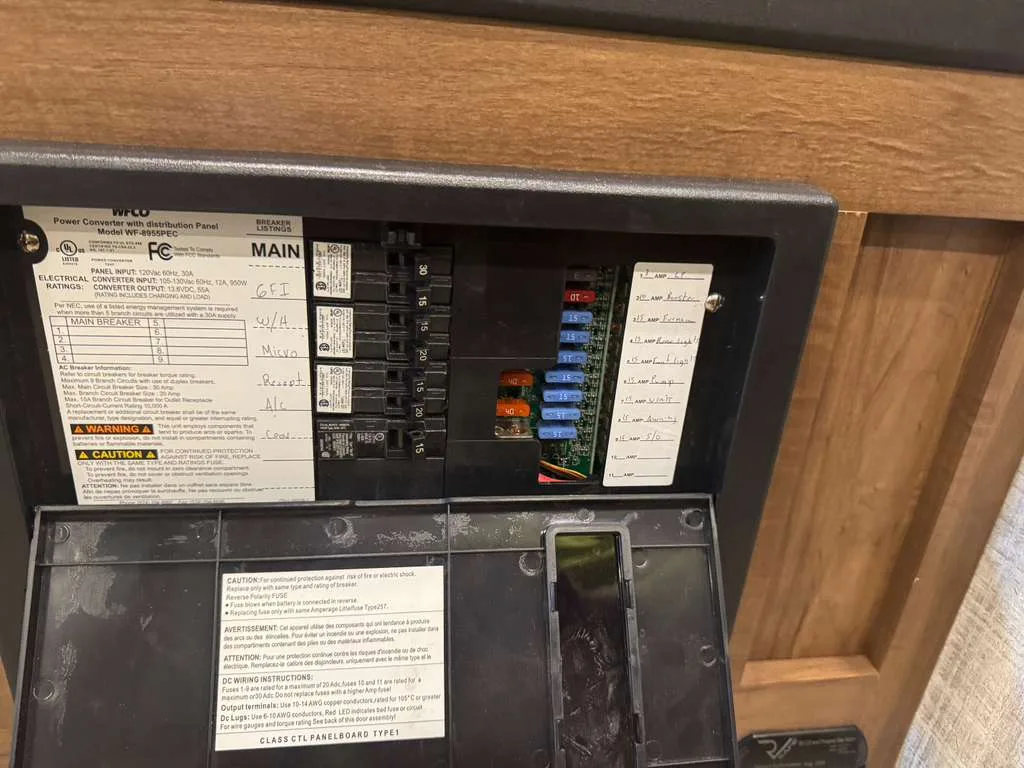
A modified sine inverter produces a stepped waveform that approximates AC. It costs less, runs efficiently, and will power incandescent and LED lighting, resistive heating elements, and many battery chargers without any issue at all. For a coach where the inverter is only used to charge phones, run a fan, or power simple 12 volt converters, a modified sine unit does the job at a lower price point.
The problem comes with specific loads that require a clean waveform. Microwave magnetrons are the most common example: the magnetron is not a simple resistive element but a device whose operating frequency depends on the quality of the AC waveform feeding it. On a modified sine inverter the magnetron either runs inefficiently and heats the food poorly, or the inverter's overload protection reads the current as a fault and shuts down. Neither outcome is the inverter being undersized; it is the inverter being the wrong type for that appliance.
Variable-speed motors present the same issue. The speed controller in a variable-speed furnace blower, a residential refrigerator compressor, or a soft-start air conditioner reads the waveform to determine frequency. A stepped modified sine signal confuses the controller, and the motor runs at the wrong speed, overheats, or trips its own protection. Any coach equipped with these appliances needs a pure sine inverter regardless of what the wattage math suggests.
Audio equipment, medical devices, and sensitive electronics with linear power supplies also belong in the pure sine category. The practical guidance for most coaches is straightforward: if you plan to run a microwave or any variable-speed appliance, specify pure sine from the start and remove that question from the equation.
Why cable sizing matters as much as the inverter itself
An inverter does not pull current from the battery at 120 volts. It pulls it at 12 volts, which means the current on the battery side of the circuit is roughly ten times the current on the AC output side, plus conversion losses. A 2,000 watt inverter running at full output draws close to 200 amperes from a 12 volt bank. That figure has to travel through the cable from the battery terminals to the inverter's DC input.
Cable undersized for that current has resistance, and resistance under heavy current produces heat. The heat shows up as voltage drop: the inverter's input voltage sags below what the unit needs to maintain output, and it trips on low voltage before the battery bank is even close to discharged. The owner assumes the batteries are bad. In almost every case the batteries are fine and the cable is the fault.
Correct cable sizing is determined by the inverter's peak rated current and the cable run length. A short run between a battery bank and an inverter mounted directly beside it can use smaller cable than a run that travels the length of the coach. The cable also needs to be properly fused close to the battery - within 18 inches where possible - because the fuse protects the cable, not the inverter, and an unfused run that shorts will heat until something burns.
This is the part of the job that DIY installations most commonly get wrong. The inverter itself often comes with terminals sized for the correct cable, but those terminals go unused and the owner connects whatever wire is convenient. The result is an installation that works at low loads and fails at high ones, which is precisely when the inverter is needed most.
Can an air conditioner run on an inverter?
Not on a typical battery bank, and not without a setup that most owners are not prepared to build. A 13,500 BTU rooftop unit draws roughly 1,500 watts in steady state and can surge to three or four times that figure on compressor startup. Even with a soft-start device reducing the startup spike to something manageable, sustaining 1,500 watts for four hours on a summer afternoon requires a battery bank of 500 amp-hours or more at usable depth of discharge, plus an inverter rated for the starting surge.
The practical limit for most coaches is that the inverter handles everything except the air conditioner. The microwave, the coffee maker, the television, the laptop, the lights, and the water pump are all within reach of a 2,000 watt inverter and a moderate lithium bank. The air conditioner runs on shore power, the generator, or a dedicated high-capacity system that most boondockers do not build. Understanding this boundary before the installation is specified avoids the disappointment of a correctly installed system that still cannot do what the owner expected.
Florida amplifies this problem. Running an air conditioner from batteries in a state where summer ambient temperatures push into the mid-nineties is not a brief comfort measure; it is a sustained load that demands serious capacity. The math is honest and it does not improve with better equipment at the same capacity.
How an inverter/charger combo replaces the converter
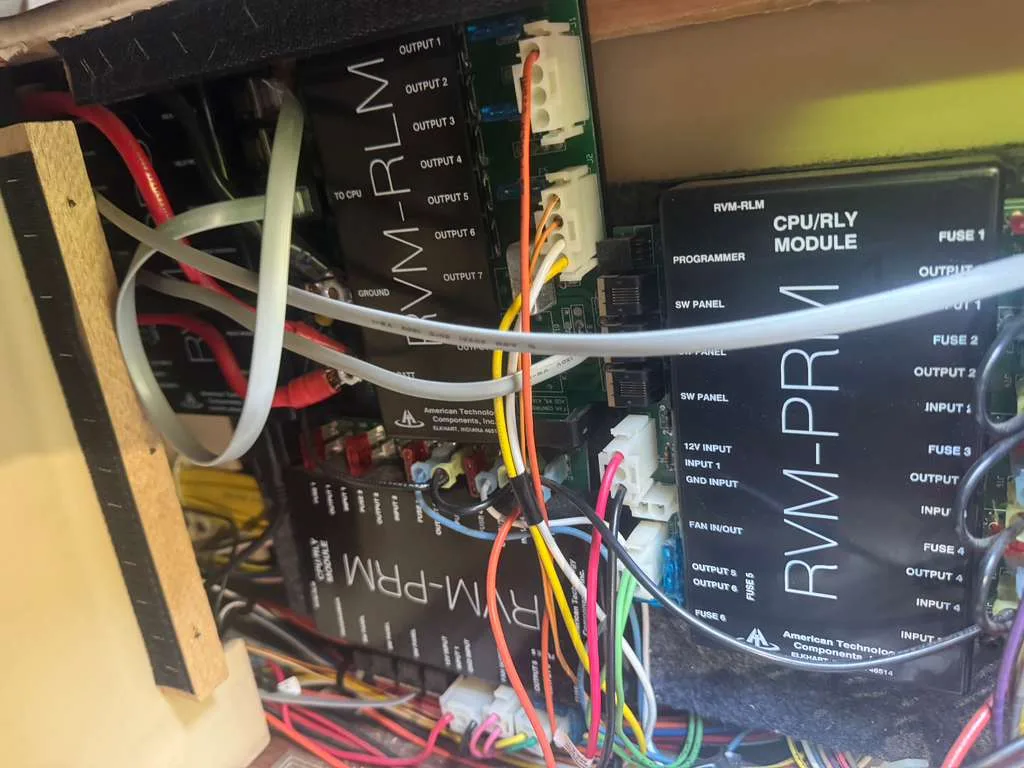
Every coach that left the factory with shore power capability also has a converter: a device that takes 120 volt AC from the shore cord and produces 12 volt DC to run the coach systems and charge the battery bank. A standalone inverter added alongside the existing converter creates two separate systems that handle power in the same direction and share no intelligence about each other.
An inverter/charger combines both functions in one unit. When shore power is available it charges the battery bank at a high rate and passes 120 volt AC through to the coach circuits. When shore power is removed it draws from the battery bank and produces 120 volt AC from it. The transition is handled automatically by an internal transfer relay, typically in under 20 milliseconds, which is fast enough that most appliances do not notice.
The practical advantage is that the existing converter is removed and replaced rather than supplemented. The wiring simplifies, the charging profile can be set correctly for the battery chemistry being used, and the unit's power-assist function can supplement the shore supply during momentary high loads. Brands like Victron, Xantrex, and Magnum all produce units designed for RV installation and have been thoroughly validated in mobile environments. The 3,000 watt range covers most coaches without needing a second unit in parallel.
The wiring for an inverter/charger installation involves the battery bank connections, the AC input from the shore cord, and the AC output to the panel or a subpanel covering the circuits intended to run on battery. That last decision - which circuits get inverter power - is made during the load assessment that precedes every installation we do.
What the load assessment determines
Before specifying an inverter size or type we add up what the coach will actually run simultaneously, not what it might conceivably run in theory. The microwave is 1,000 to 1,500 watts. A coffee maker is 800 to 1,200 watts. A television is 60 to 150 watts. A laptop charger is 45 to 100 watts. Lighting on a modern coach is typically under 100 watts total. A residential refrigerator compressor is 150 to 250 watts running but can spike to 700 watts starting.
The sum of the realistic simultaneous loads determines the inverter's continuous rating requirement. The largest single starting surge - almost always the refrigerator compressor if a residential unit is fitted - determines the inverter's surge rating requirement. Sizing to 125 percent of the continuous load and confirming the surge rating clears the compressor start gives the inverter enough headroom to perform without nuisance tripping.
Battery bank sizing is a separate calculation. Divide the total watt-hours needed between charges by the usable percentage of the bank capacity. A lithium bank at 80 percent depth of discharge delivers nearly double the usable capacity of a same-size AGM bank at 50 percent depth of discharge. That difference is why lithium is the preferred chemistry for any serious inverter installation, and why the charger profile in the inverter/charger has to match the battery type precisely.
Transfer switch: keeping shore power and inverter output separated
An automatic transfer switch is the device that ensures shore power and inverter output never appear on the same circuit at the same time. Without it, connecting shore power while the inverter is producing output puts two voltage sources in parallel, which will damage one or both. In an inverter/charger this switching is built in. In a standalone inverter installation it has to be added.
The transfer switch monitors the shore supply and connects whichever source is available to the designated circuits. When shore power arrives the inverter output is disconnected first, then shore power is connected. When shore power fails the sequence reverses. The switching time matters for sensitive electronics but is unimportant for most loads. An automatic transfer switch in the $280 to $580 range handles this reliably for a typical coach installation and removes the risk of backfeeding entirely.
Florida campgrounds with unreliable pedestals make automatic transfer switches genuinely useful rather than optional. A pedestal that drops voltage or goes completely dark for a few minutes during a storm benefits from a system that handles the transition without the owner needing to do anything. We include this in every standalone inverter installation for that reason.
How long will the batteries last running a 2,000W inverter?
Divide the usable battery capacity in watt-hours by the average load in watts to get the approximate runtime. A 200 amp-hour lithium bank at 80 percent depth of discharge holds 1,920 watt-hours of usable capacity. Running a 2,000 watt load continuously would drain it in under an hour. Running a 400 watt average load - a realistic figure for an evening of television, lighting, and occasional phone charging - gives roughly four to five hours before the bank needs a charge.
The microwave changes the math dramatically because it runs at full rated power while it runs but only runs for two to four minutes at a time. A 1,200 watt microwave running for three minutes consumes 60 watt-hours per use, which is a small fraction of a reasonable battery bank. The problem is not the microwave's duration but its peak demand while running: the inverter must be capable of sustaining 1,200 watts continuously for those minutes, which a correctly sized pure sine unit handles without issue.
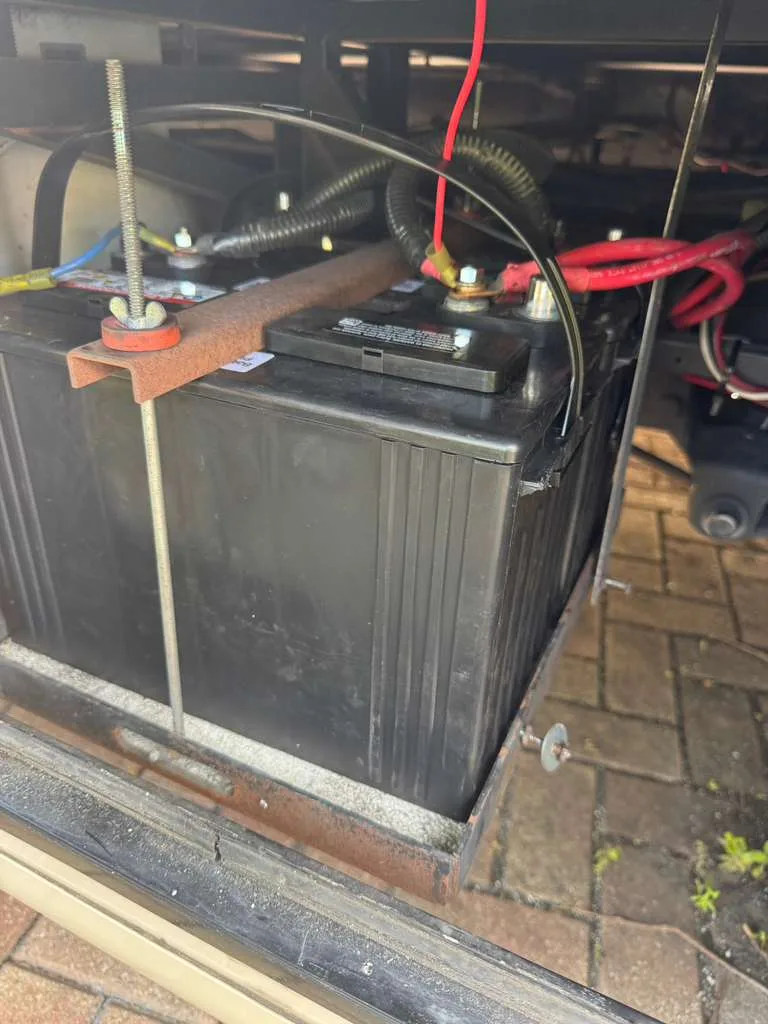
Runtime tables and calculations are starting points, not guarantees. Temperature affects both battery capacity and inverter efficiency. A hot Florida battery compartment in August runs less efficiently than a conditioned space, and lithium capacity decreases measurably above 40 degrees Celsius. Ventilation for both the inverter and the battery bank is part of every installation we plan, not an afterthought.
What Does Mobile RV Inverter Installation Cost?
These are typical ranges for mobile service across Florida. A brief description of what is included is in the Notes column.
| Service | Typical Range | Notes |
|---|---|---|
| Service call + load assessment | $299 - $399 | Includes load analysis and cable-run planning |
| 1000W pure sine inverter (installed) | $350 - $650 | Basic electronics and lighting loads |
| 2000W pure sine inverter (installed) | $550 - $950 | Microwave, coffee maker, most 120V appliances |
| 3000W inverter/charger combo | $950 - $1,800 | Xantrex, Victron, or Magnum; replaces the converter |
| Inverter transfer switch (auto) | $280 - $580 | Automatic switching between shore power and inverter |
Service call (trip charge + first hour) is $299-$399 depending on location - confirmed when you book. Repair line items below are national averages for mobile service (2025 data) and represent labor + parts after the first hour. Call (888) 702-6880 for an exact quote.
Inverter questions RV owners ask us
What is the difference between a modified sine and pure sine inverter?
A modified sine inverter produces a stepped waveform that approximates AC. It runs resistive loads like incandescent lights and basic heating elements without issue. A pure sine inverter produces a smooth waveform identical to shore power, and it is what microwave magnetrons, variable-speed motors, and most electronics with switching power supplies actually require. If you have experienced a microwave that trips the inverter or runs slow, the output type is almost certainly the cause.
Can I run my air conditioner on an inverter?
Not on a typical residential battery bank without a very large and expensive setup. A 13,500 BTU rooftop unit draws roughly 1,500 watts running and can spike to three times that on startup. Sustaining that load for several hours requires a battery bank that most coaches simply do not carry, plus cable and inverter sizing to match. Soft-start devices reduce the startup spike considerably and make it marginally more practical, but it remains a significant commitment in both battery capacity and cost.
Why does my inverter trip when I start the microwave?
Because the microwave magnetron requires a pure sine waveform to start cleanly, and the startup surge on a modified sine inverter exceeds what the unit tolerates. The inverter reads this as an overload and shuts down to protect itself. The fix is either a pure sine inverter sized correctly for the microwave load, or confirming that your current inverter is rated above the microwave's peak starting draw.
What size inverter do I need for full-time boondocking?
Add up the wattage of everything you plan to run at once, then size the inverter to at least 125 percent of that figure to give it headroom. A microwave alone is 1,000 to 1,500 watts. Add a coffee maker, a laptop, and lights and a 2,000W pure sine unit is a reasonable starting point for most coaches. The battery bank has to be sized independently to sustain that load for however many hours you need between charging opportunities.
Is an inverter/charger better than a separate inverter and converter?
For most installations yes. An inverter/charger from Victron, Xantrex, or Magnum combines both functions in one unit, uses a single set of cables, and manages the transition between shore power charging and battery-powered inversion automatically. It also replaces the OEM converter entirely, removing the redundancy. The tradeoff is cost - a quality 3,000W inverter/charger runs considerably more than a standalone inverter added alongside an existing converter.
Sources
- Victron MultiPlus II documentation - Power assist functionality and wiring diagrams for the common RV inverter/charger.
- Xantrex RV inverter documentation - Freedom XC and SW series wiring, configuration, and battery sizing guides.