Mobile RV Power Converter and Charger Replacement Across Florida
The converter takes shore power and charges your batteries while powering 12V loads. When it fails, everything on 12V goes dark. Most converter replacements are done in under two hours at the coach.
Most factory RV converters are single-stage units. They push a fixed bulk voltage - typically 13.6 volts - regardless of whether the battery is at 50 percent charge or 99 percent. That is adequate for a coach on hookup for a weekend. It is quietly destructive for a coach stored on shore power for weeks or months, because there is no mechanism to drop back to a float voltage once the bank is full. The result is sustained overcharging: water boils out of flooded cells, plates corrode, and capacity is permanently lost. The batteries are blamed, replaced, and damaged again by the same converter. A 4-stage charger - the kind in a Progressive Dynamics Inteli-Power or an upgraded WFCO unit - eliminates the problem by design, because it automatically drops to a safe absorption and then a true float once the bank is satisfied.
What does the converter actually do - and what it does not do
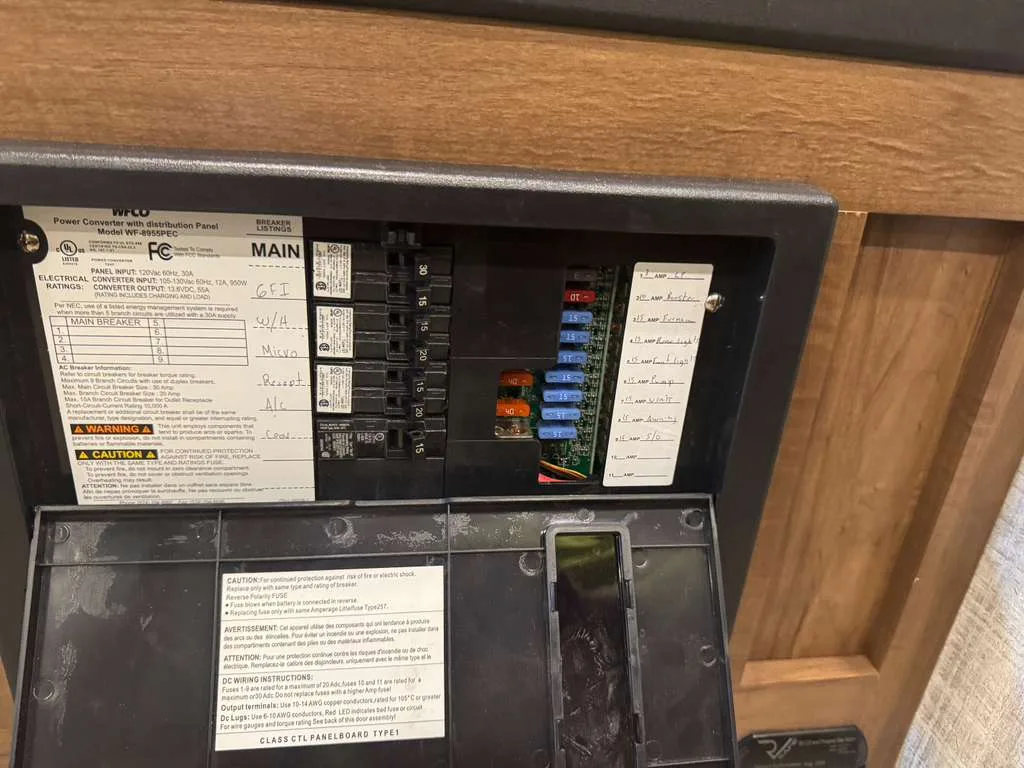
The converter takes the 120 volt AC from your shore cord or generator and converts it to 12 volt DC. It does two things at once: it charges the battery bank and it directly powers the 12 volt loads - lights, water pump, furnace fan, slide controls, and anything else on the coach's 12 volt bus. This matters because on shore power your 12 volt loads are running off the converter output, not the batteries. The batteries are in parallel with that output, absorbing charge and acting as a buffer.
What the converter does not do is invert. It cannot take 12 volt DC from the batteries and produce 120 volt AC for your outlets. That is what an inverter does, and an inverter/charger does both. A great many owners confuse the two - specifically when their outlets work on shore power but go dead when they disconnect. That is the converter doing exactly what it is designed to do, and it is not a failure.
Understanding that boundary also clarifies why a failed converter presents as a 12 volt problem even though it lives on the 120 volt side. The outlets keep working. The microwave keeps working. But the lights dim, the pump slows, and eventually the batteries, no longer being charged, run flat.
How a dumb converter damages batteries during storage
A single-stage converter holds a fixed output voltage. When you connect shore power to a coach with a depleted bank, the current flowing into the batteries is high because the difference between the converter's output voltage and the battery's resting voltage is large. As the bank charges, that difference narrows and the current tapers naturally. Eventually the bank reaches the converter's set point and the current drops nearly to zero. So far, so normal.
The problem is what happens next. A properly designed 4-stage charger detects that the bulk charge phase is complete and transitions to a lower absorption voltage, then to a float voltage - usually around 13.2 volts - that maintains the bank without stressing it. A single-stage unit does no such thing. It holds its set point indefinitely. If that point is 13.8 volts, the bank sits at 13.8 volts for the entire time the coach is plugged in - a week, a month, all winter. At that sustained voltage, electrolyte slowly gasses off in flooded lead-acid cells, the plates sulfate, and capacity degrades. Owners who store their coach plugged in and wonder why their batteries need replacement every couple of seasons are usually looking at this mechanism, not a battery quality problem.
The fix is to replace the converter with a 4-stage unit. In practice, this means installing a WFCO WF-8930 series or a Progressive Dynamics PD4000 series in place of the original Magnetek or Parallax. The physical swap is usually straightforward because these units are designed as drop-in replacements and share the same mounting footprint and wiring connections.
WFCO versus Progressive Dynamics Inteli-Power - what the difference actually means at the coach
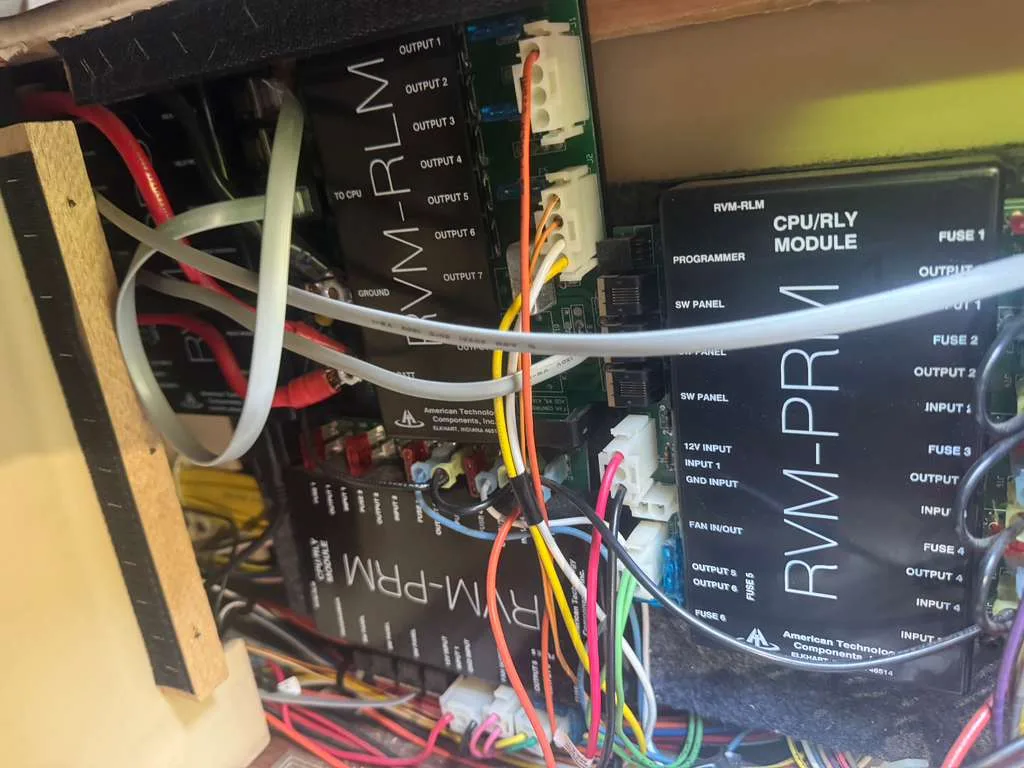
Both brands produce 4-stage converters and both are significant improvements over the single-stage units they replace. The differences matter for specific situations.
WFCO units - particularly the WF-8930, WF-8945, and WF-8955 - are the most common OEM replacement across mid-range coaches. They are reliable, competitively priced, and the drop-in fit for a Magnetek 30-amp unit is nearly universal. The WF-8930 delivers 30 amps of total current, which is sufficient for most coaches with a single house battery and moderate 12 volt loads. The WF-8945 and WF-8955 step up to 45 and 55 amps respectively for coaches with larger battery banks or high draw loads. WFCO units also include a built-in distribution panel in many configurations, which simplifies the install.
Progressive Dynamics Inteli-Power units - the PD4045, PD4060, PD4135 and similar - include what Progressive Dynamics calls Charge Wizard technology, which actively monitors battery voltage and adjusts the charging profile in real time. The most notable feature for stored coaches is the automatic transition to a boost mode when the unit detects a battery that has sat at float voltage for an extended period and needs a short refresh cycle. This is genuinely useful for seasonal storage. Progressive Dynamics units also tend to run quieter at light loads because the fan is temperature-controlled rather than always-on.
In practice, either brand transforms the charging situation compared to the original converter. For a coach that lives plugged in during Florida winters, the Progressive Dynamics Charge Wizard is worth the price premium. For a coach used more regularly where storage overcharging is less of a concern, the WFCO is the pragmatic choice.
Reading the converter fan - what continuous running actually means
The fan on an RV converter is a thermal management device. It runs when the converter's internal temperature rises above a threshold, and it stops when the temperature falls back. On a 4-stage unit with a temperature-controlled fan, that means the fan is off most of the time when the bank is fully charged and shore power is connected at moderate ambient temperature.
Continuous fan running has two common legitimate causes, and one that is worth investigating. The first legitimate cause is a deeply discharged battery bank demanding maximum charge current. High charge current produces heat; the fan runs to remove it. This is normal and will resolve as the bank charges up. The second is a high ambient temperature inside the bay where the converter lives. In Florida in July, the converter compartment on a coach parked in the sun can reach temperatures well above the fan's trigger point without any fault at all.
The cause worth investigating is a sulfated or failing battery bank. Sulfated batteries present an abnormal internal resistance. The converter has to work harder to push current into them, generates more heat at partial charge, and keeps the fan running longer than it should on a healthy bank. If your converter fan runs continuously on a bank that should be fully charged in a cool environment, that is the first thing to check - the converter may be fine and the batteries are the problem. Catching this early matters because a sulfated bank only deteriorates further under the same conditions.
Converter hum versus fan noise - two distinct sounds with different implications
Owners report converter noise in two ways that mean different things and require different responses. Knowing which one you are hearing saves time and money.
Transformer hum is a low, steady vibration at 60 Hz - the line frequency. It comes from the converter body itself, specifically the transformer core. On ferro-resonant converters, which were fitted to older coaches well into the 1990s, this hum is essentially inherent to the design and does not indicate a fault. On newer switch-mode converters like the current WFCO and Progressive Dynamics units, transformer hum is much less pronounced and a significant increase in that hum - particularly if accompanied by a drop in output voltage - can indicate a transformer problem. But a constant mild hum that has been there since the coach was new is almost always the transformer doing its job.
Fan noise is higher-pitched, variable, and usually intermittent. A bearing wearing out in the fan produces a grinding or squealing quality that gets worse over time. Debris caught in the blade produces an irregular ticking or buzzing that may stop and start. Fan noise is generally an easy fix - the fan is a separate component and replaceable without touching the converter module itself. The important point is that fan noise and transformer hum can overlap, especially at lower fan speeds, and owners sometimes interpret both as one concerning sound and conclude the converter is about to fail. In most cases the converter module is fine.
How to separate a converter failure from a battery failure before calling
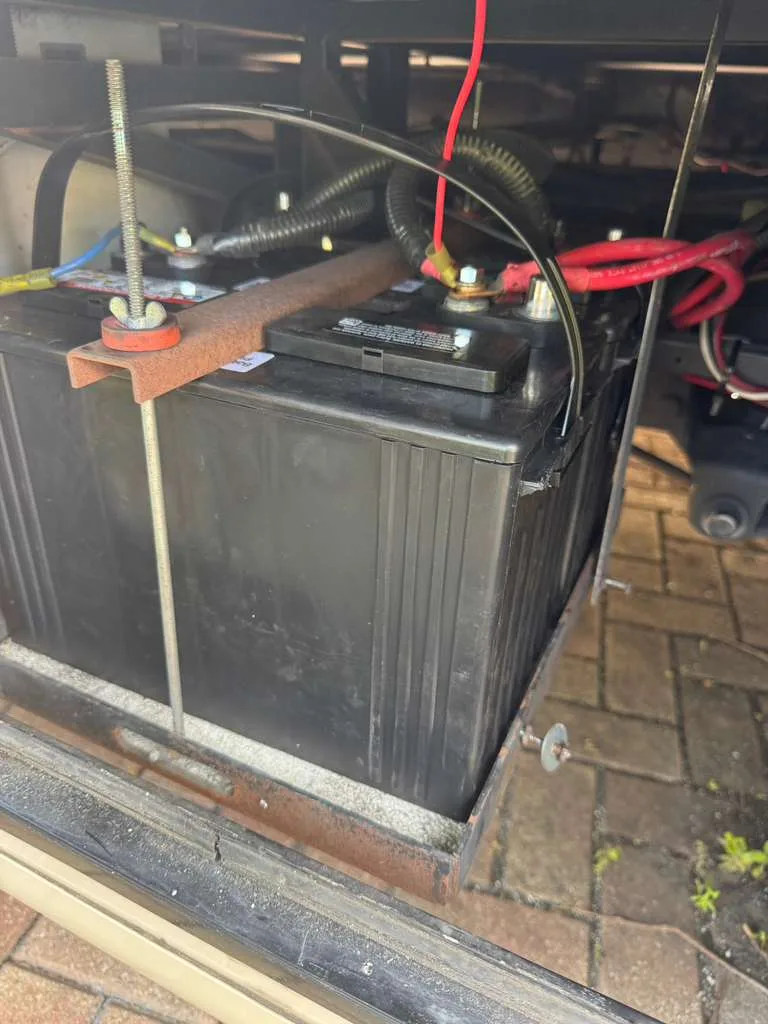
This is the most common diagnostic question we get, and it resolves cleanly with two measurements taken in sequence. You need a multimeter - a basic $20 unit from any hardware store is sufficient.
First, with shore power connected, measure the voltage directly at the battery terminals. A converter that is delivering charge will hold the bank at 13.6 to 14.4 volts during the bulk charge phase, or at around 13.2 volts at float. If the voltage at the battery sits at 12.6 volts or below with shore power connected, the converter is not delivering charge. It may have failed entirely, or its output fuse may have blown, or the wiring between the converter and the battery has an open. The batteries are not the problem in this reading - they are simply not being charged.
Second, disconnect shore power and put a modest load on the bank - a few interior lights and the water pump running briefly is sufficient. Measure battery voltage immediately after disconnecting, then again two minutes later under that load. A healthy bank holds within a few tenths of a volt. A failed bank collapses - dropping from 12.6 to below 11.5 under that load within seconds. That is the measurement that condemns a battery rather than a converter.
The situation that confuses most owners is a coach that runs perfectly on shore power and dies the night after disconnecting. That is almost always a battery failure, not a converter failure. The converter was working correctly the whole time it was connected - keeping the bank at a maintained voltage - and once that support was removed, the bank could not sustain the overnight parasitic draws. The converter gets blamed for a failure it did not cause.
What a converter replacement involves on the day
Most converter replacements take between 90 minutes and two hours at the coach. The process is straightforward when the unit is a standard module within an existing distribution center, which covers the majority of coaches made after the mid-1990s.
We begin with a voltage and load test of the existing battery bank to establish its condition before the converter comes out. If the batteries are significantly degraded, replacing the converter alone may not restore full 12 volt performance - and the owner should know that before the work starts rather than after. We then isolate the shore supply, remove the converter module, confirm the replacement is the correct amperage for the existing wiring and distribution setup, and wire in the new unit. The output is tested under load and the charging profile verified before we close up.
The one complication that extends the job is an older coach where the converter and the distribution panel are integrated into a single assembly rather than separate modules. In that case the options are a complete panel replacement or adapting the existing enclosure to accept a standalone converter - a decision we make on-site based on what is actually there. Either way, the work is done at your location without a shop tow.
What Does Mobile RV Converter Replacement Cost?
These are typical ranges for mobile service across Florida. The Notes column describes what each line item includes.
| Service | Typical Range | Notes |
|---|---|---|
| Service call + output voltage test | $299 - $399 | Includes load test and fan/thermal check |
| WFCO 30A converter (installed) | $185 - $380 | Most common OEM replacement; drop-in for Magnetek units |
| WFCO 45A or 55A converter (installed) | $250 - $480 | High-draw coaches with multiple 12V loads |
| Progressive Dynamics Inteli-Power (installed) | $280 - $550 | 4-stage charging; better for battery health during storage |
| Inverter/charger upgrade | $950 - $1,800 | Replaces converter and adds inverter function for off-grid use |
Service call (trip charge + first hour) is $299 - $399 depending on location - confirmed at booking. Converter line items are labor plus parts and represent national averages for mobile service (2025 data). Call (888) 702-6880 for an exact quote based on your coach and location.
Converter questions we get asked regularly
How do I know if my converter is failing versus my batteries are bad?
Plug into shore power and measure the voltage at the battery terminals. A working converter holds the bank at 13.6 to 14.4 volts while charging. If it sits at 12.6 or below, the converter is not delivering charge and the batteries are being blamed for its failure. Then disconnect shore power and put a modest 12 volt load on the bank - a few lights or the water pump. A healthy bank holds voltage; a failed one collapses within minutes. That two-step test separates a dead converter from a dead battery every time.
What does the converter fan running constantly mean?
It usually means one of two things: a thermal overload condition from high ambient temperature or a deeply discharged bank demanding maximum charge current - both of which are normal. It becomes worth investigating if the fan runs continuously on a bank that should be fully charged in a cool environment, which can indicate sulfated batteries making the converter work harder than it should. A converter that has genuinely failed typically stops rather than runs faster.
Why does my converter make a humming noise?
There are two distinct sounds. A low steady hum from the converter body is the transformer core vibrating at 60 Hz and is normal, especially on older ferro-resonant designs. A higher-pitched noise from the fan is either a worn bearing or debris in the blade - an easy fix that does not require replacing the converter module. The two can overlap at lower fan speeds and get misread as one alarming sound. If the hum is accompanied by low output voltage, that is worth a proper diagnosis. A hum that has been present since the coach was new is almost certainly the transformer doing its job.
Can I upgrade to a smarter converter without replacing the whole distribution panel?
In most cases yes. WFCO and Progressive Dynamics units are designed as drop-in replacements for older Magnetek and Parallax converters and share the same bolt pattern and wiring harness connections on the most common coach sizes. The distribution panel stays in place; only the converter module is swapped. The exception is coaches where the converter and the main AC distribution are integrated into a single enclosure - in that case the scope is larger, but a full panel replacement is often still not necessary.
What is the difference between a converter and an inverter/charger?
A converter takes 120 volt AC from shore power and produces 12 volt DC to charge the batteries and run 12 volt loads. It works in one direction and needs a shore or generator supply to do anything. An inverter/charger adds the reverse function: it can take 12 volt DC from the batteries and produce 120 volt AC for your outlets when no shore power is present. It also contains a charger, so on hookup it behaves like a 4-stage converter. The upgrade costs significantly more but removes the dependency on external power for running 120 volt appliances - useful for boondocking or extended off-grid stays.
Sources
- WFCO Electronics converter documentation - WF-8930, WF-8945, and WF-8955 series specs, wiring diagrams, and fault codes.
- Progressive Dynamics Inteli-Power documentation - 4-stage charging profiles and replacement guide for Magnetek converters.