RV Awning Care in Florida: What Actually Damages Them and How to Prevent It
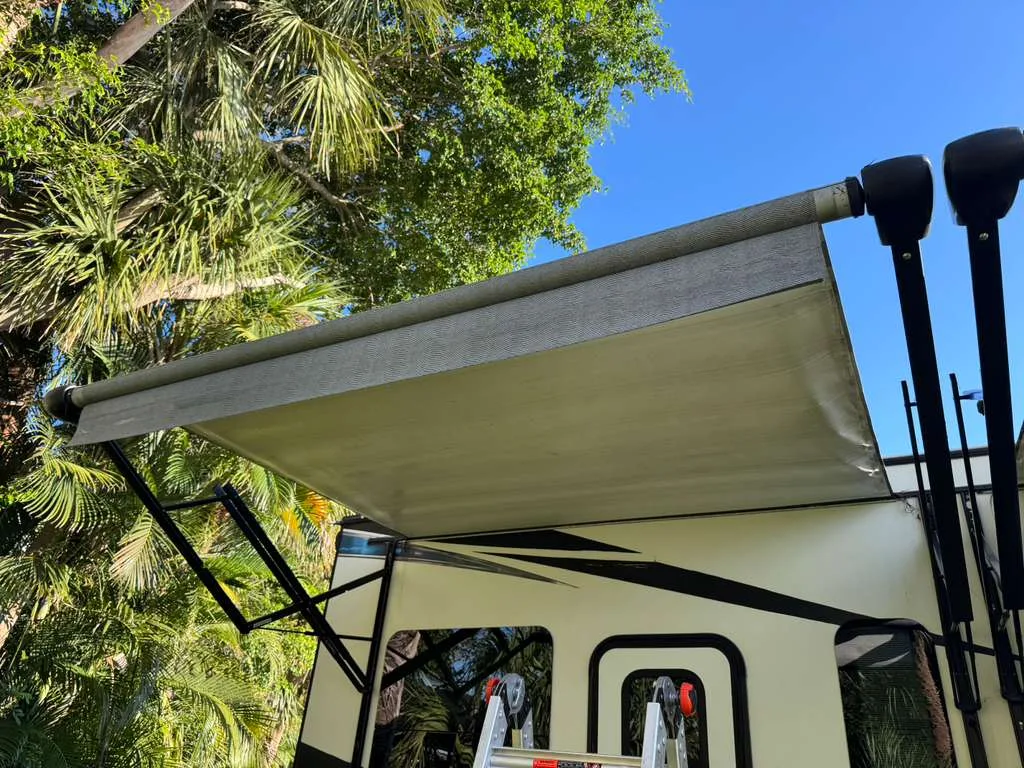
Three things damage Florida RV awnings faster than anything else: UV exposure that is not managed with a protectant spray, leaving the awning out during afternoon storms that build daily from May through September, and rolling it in wet. Any one of them on its own will cut the fabric life by half. All three together will end it in a single Florida summer.
How does Florida's UV actually damage awning fabric?
It breaks down the acrylic or vinyl coating that makes the fabric waterproof and UV-stable, which is a gradual process that becomes visible as fading, then as chalking on the surface, then as the fabric losing its ability to shed water cleanly.
Florida's UV index reaches ten to eleven from May through September, which is the highest category on the scale. Standard awning fabric is tested and rated under lower UV loads. A fabric that would last eight to ten years in the Midwest can begin showing UV failure at three to four years in South Florida without a protectant routine.
The failure pattern to watch for is color shift from even fading to a chalky, blotchy look where the surface coating is breaking down unevenly. At that stage the fabric is still functional but the UV protection in the coating is mostly gone, and the degradation accelerates from there.
A UV protectant spray applied twice per season - once in spring before the intense UV period begins and once in fall - extends the fabric life significantly. Apply it to a clean, dry fabric surface, allow it to dry fully before rolling the awning in, and use a product specifically rated for the fabric type on your awning.
When should the awning come in ahead of a storm?
Anytime there is a thunderstorm within thirty miles that is tracking toward you, which in Florida during summer means checking the radar before you sit down for lunch every afternoon.
Florida's afternoon convective storms build fast and arrive with little warning at street level. A storm that looks distant on radar can produce damaging wind gusts as the outflow hits ground level several miles ahead of the visible cloud. An awning that is out in a thirty-mile-per-hour gust is in danger of arm failure, and the standard canopy arms are not rated for the wind loads a typical Florida afternoon thunderstorm produces.
The practical rule is simple: if the sky is building or if the forecast shows afternoon thunderstorms, retract before noon and put it out again in the evening if the storms have passed. A storm-damaged awning arm often takes the wall mount with it, which is a significant structural repair rather than an awning replacement.
Most modern electric awnings have a wind sensor that retracts automatically. If yours has one, test it seasonally - they can fail in the stored position, giving you confidence the awning will retract when it will not. Test it by running the sensor under a hair dryer or a heat gun briefly at low heat to verify the mechanism responds.
How do you clean awning fabric correctly?
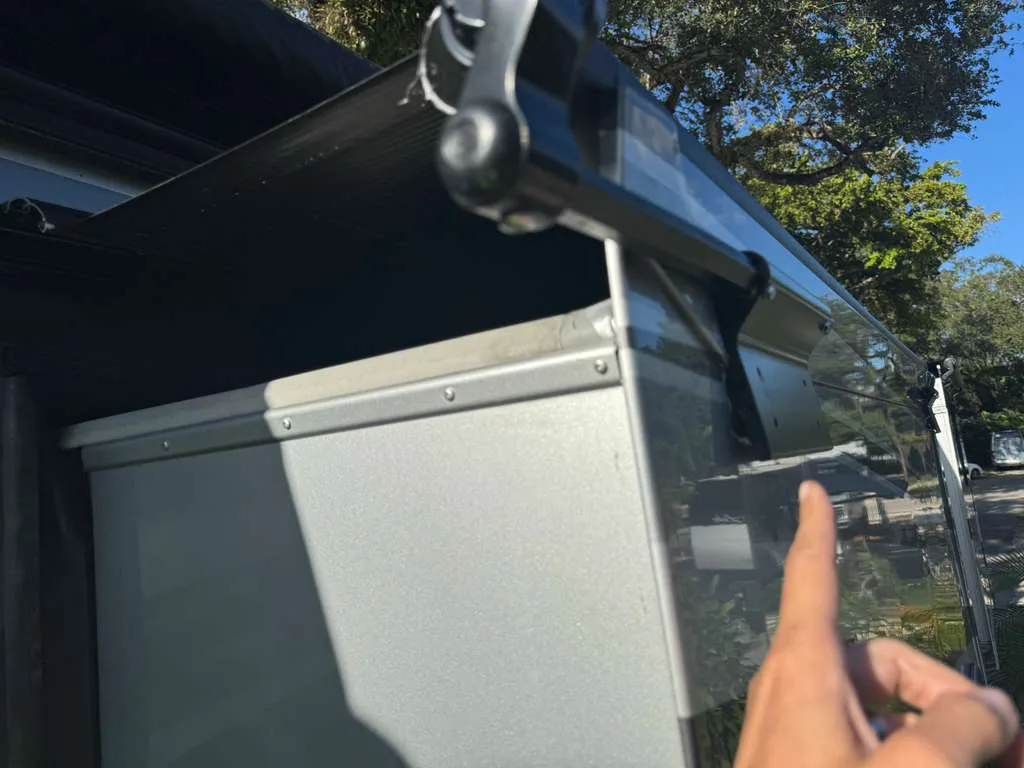
Clean it extended, never rolled. Cleaning a rolled awning traps moisture inside the roll and creates exactly the mold conditions you are trying to prevent.
Use a soft brush and a mild soap - dish soap works, as does a purpose-made awning cleaner. Avoid bleach on acrylic fabric; it degrades the thread and the coating. Bleach is appropriate for vinyl fabric in diluted form when mold is present, but even then a purpose-made mold remover designed for vinyl is less damaging over time.
Work from the center outward and let gravity take the soap water away from the roller end, which is where water pools if it runs back along the fabric. Rinse thoroughly because soap residue left in the fabric attracts dirt faster and can degrade the UV coating over time.
Most importantly, let it dry completely before rolling it in. A damp awning rolled for storage is a mold incubator. In Florida's humidity, this can produce visible mildew within forty-eight hours of rolling wet, so if you had to retract for a storm and the fabric is wet, deploy it again as soon as the storm passes and let it dry fully before the day ends.
What does mildew on the fabric mean and how far does it go?
Surface mildew is dark spotting on the fabric that wipes off with a cleaner - it is on the surface rather than in the weave, and it is reversible with a proper cleaning. Mildew that has embedded itself in the weave is a different situation - it leaves behind staining that does not clean off and eventually weakens the thread.
On acrylic fabric, mildew grows on surface organic matter - pollen, bird droppings, tree debris - rather than on the fabric itself. Keeping the fabric clean removes the food source and prevents the mildew from establishing even in Florida's humidity. A fabric that has been mildewing repeatedly has a surface that is not being kept clean, which is a maintenance issue rather than a product failure.
On vinyl fabric, mildew can grow directly on the surface and the spores can work into the grain of the vinyl over time. A vinyl awning that smells musty when deployed has mildew in the fabric surface even if the visible spotting has been cleaned off. A mold remover applied and left to dwell for fifteen minutes before rinsing addresses the subsurface colonization that a surface wipe does not.
If mildew staining is visible after a thorough cleaning, the fabric has degraded past the point where cleaning helps aesthetically. It is still functional if the structural integrity is intact, but the appearance will not recover and the degradation will continue.
What does spring tension tell you about the arms?
On a manual awning, the arm tension is controlled by springs in the arm assemblies. An awning that deploys with noticeably less resistance than it used to, or that does not stay out without a support pole at moderate wind speeds, has lost spring tension. This is usually a gradual change that owners stop noticing because it happens incrementally.
Deploy the awning fully and push up gently on the middle of the awning arm from below. A healthy arm with adequate spring tension resists this pressure clearly. An arm that deflects easily under modest hand pressure has lost tension and is at risk of arm failure in wind conditions that a properly tensioned arm would handle.
Spring replacement is a defined service procedure on most awning systems and restores the original tension. Ignoring it means running with an awning that is more vulnerable to wind damage than it should be, and that vulnerability is invisible until it fails. The cost of spring replacement is a small fraction of replacing an arm or the wall mount after a failure.
Our awning service page covers both spring adjustment and arm replacement. Checking the tension annually as part of a spring inspection is the routine that prevents the unplanned repair.
What does bracket wobble tell you about the wall mount?
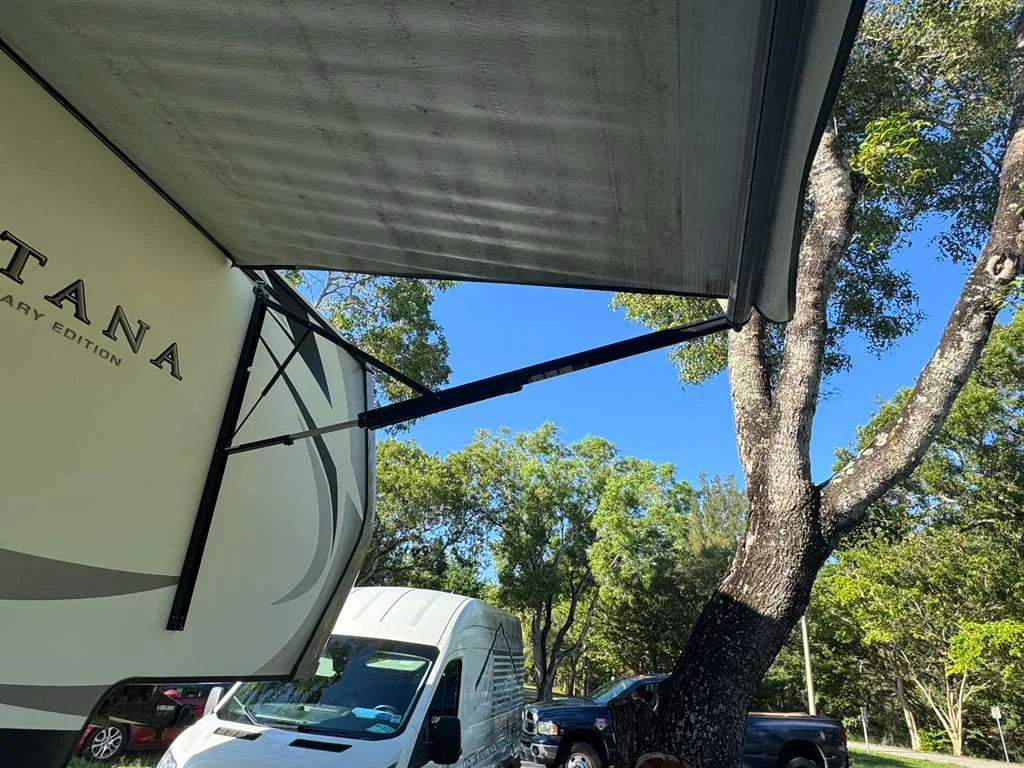
The wall mount bracket is the point where the entire awning assembly is attached to the coach wall. Any wobble, play or creaking in the bracket when you push on the awning arm is a signal that the mount is not secure, which is a structural concern because the wall behind it may have compromised fastener holes or water damage around the attachment points.
Push on the awning arm laterally and then upward while watching the bracket from the side. Movement in either direction means the fasteners have loosened or the wall substrate behind the mounting surface has softened. Tightening the fasteners solves the first case. A softened wall substrate - which is usually a water damage issue at the wall penetration - requires removing the bracket and addressing the wall before remounting.
A bracket that has been through a partial arm failure may look intact but have deformed or cracked the wall skin around the mounting holes. That is not visible from outside without removing the bracket. If the coach has had any prior awning arm incident, the bracket mount should be inspected during the next awning service.
Florida's thermal cycling - going from cool nights to hot afternoons year-round - works fasteners loose faster than in climates with seasonal temperature extremes. Including the wall mounts in an annual inspection prevents a mount failure that would otherwise arrive unannounced.
When is replacement more practical than repair?
When the fabric has failed UV-wise across more than thirty percent of its surface, when it no longer sheds water cleanly in its center sections, or when mildew staining covers more than a quarter of the visible fabric. Fabric is a wear item and there is a point where patching or cleaning no longer makes economic sense against the cost of a new fabric panel.
A fabric-only replacement uses the existing arms, roller and end caps. If those components are in good condition, a fabric swap is straightforward and significantly less expensive than a complete awning replacement. The arm condition is the deciding factor.
An arm that has bent, fatigued, or had a partial failure event is not restorable to factory specification. A replacement arm brings the tension and alignment back to where it should be. Replacing the fabric on an arm that is fatigued puts new fabric at risk from the first storm because the arm cannot hold tension correctly.
A full awning replacement with new fabric, new arms and new hardware is the most straightforward outcome when multiple components have reached end of life at the same time, which happens on coaches that were not maintained on a regular inspection cycle. The cost difference between fabric-only and full replacement is often smaller than owners expect.
What should an awning inspection cover annually?
Fabric condition: UV degradation, mildew, tears at the seams and grommets, and whether it sheds water correctly in the center. The center is where rainwater pools if the fabric has begun to sag, and a persistent sag means the roller tension has been lost or the awning is deployed at too flat an angle.
Arm tension and range of motion: whether both arms deploy to the same length and hold their position under light pressure. A mismatched arm length means one spring has lost more tension than the other, and the uneven load that creates will show up as fabric wear on the low side over time.
Roller function: whether the roller advances smoothly during retraction without skipping or binding. A roller that skips is rolling the fabric unevenly, which creases it and accelerates wear at the crease line. Clean the roller surface and the fabric edge that contacts it as part of the inspection.
Wall mount security: the bracket check described above, including a visual inspection of the wall skin around each mounting point for any sign of cracking or separation. Add any fasteners that have backed out, and note any that spin freely rather than tightening - those indicate the wall substrate behind the mount has been compromised.
Questions owners ask about RV awning care and replacement
How often should I clean my RV awning in Florida?
Every six to eight weeks during the summer season, when pollen, bird droppings and organic debris accumulate fastest and when mold can establish in days rather than weeks. Twice per season is sufficient for a coach stored in a covered location. The cleaning interval should be driven by what you see on the fabric rather than a fixed schedule.
Can I pressure wash my awning fabric?
At low pressure, yes - below 500 PSI and held at least eighteen inches from the fabric. High pressure washes away the UV protective coating unevenly and can damage the seams and grommets. A soft brush with soap and a standard garden hose is the safer method and produces the same result.
My awning makes a grinding sound when I retract it - what is that?
Most commonly the roller mechanism, which collects dirt and debris over time. Clean the roller ends and the guide channel the fabric travels through, then apply a silicone lubricant to the roller shaft. If the grinding persists after cleaning and lubrication, the roller bearing may have failed and the awning needs a service call.
How do I know if my awning fabric needs replacement?
The two clear signs are water that no longer beads off the center of the fabric - it soaks in instead - and fading that has progressed to chalking or thread visibility in the weave. An awning that soaks through in rain or that shows thread wear in the center section has reached end of fabric life regardless of how the edges look.
Should I leave the awning out overnight in Florida?
In summer, no. Overnight dew combined with morning humidity is enough to produce mildew on a fabric that was deployed for an extended period. In Florida's dry season from November through April, overnight deployment is lower risk but still not recommended for extended periods. The safest habit is to retract at sunset and deploy in the morning after the dew has burned off.
What is the lifespan of a quality RV awning in Florida?
Six to eight years with a consistent maintenance routine including UV protectant application, regular cleaning, and immediate retraction before storms. Without that routine, four to five years is more realistic in South Florida's UV and humidity. Some owners extend fabric life to ten-plus years with meticulous care, but that requires treating it as a regular maintenance item rather than a set-and-forget component.
Sources
- Dometic - product support - Dometic owns Carefree of Colorado and provides service documentation for their awning lines, including fabric maintenance, arm adjustment and component replacement procedures.
- US EPA - mold guidance - Mold establishment conditions that apply directly to awning fabric in humid climates like Florida - what moisture levels and temperatures allow it to grow.
- US EPA - Sun Safety and UV Radiation - EPA's UV index data and sun safety guidance - Florida's UV intensity relative to the rest of the country is the same factor that degrades awning fabric faster here.
- US Fire Administration - fire prevention - Wind and storm safety context for RV awnings - why retraction before storm winds is the correct safety procedure.