The grinding noise a Schwintek slide makes is almost always the tongue-and-groove gear rack wearing through, not a failing motor. The rack degrades fastest at the extreme travel positions - the exact points where the drive pinion dwells and applies peak torque on every cycle. Because the motor still turns and the room still moves (just noisily and unevenly), owners order a motor. Replacing the motor without replacing the rack puts a new motor on damaged teeth and repeats the failure within a season at a much higher total cost.
Lippert's Schwintek in-wall slide system changed how manufacturers built coaches after 2010. By running the drive mechanism inside the wall cavity rather than through a large tube in the floor, it allowed lighter construction and thinner wall sections. Coaches that might have carried a bulky through-frame rack under the floor now had a clean, low-profile room that traveled on vertical gear racks mounted on each side of the opening. The trade-off, which Lippert has never advertised prominently, is that all the drive load rides on those racks - and the racks are a precision plastic composite that wears.
When an owner describes a grinding or clicking noise that appeared gradually over several seasons, this is where Jesse Marcer starts the inspection, not at the motor. The motor amp draw tells part of the story, but the gear teeth tell the rest.
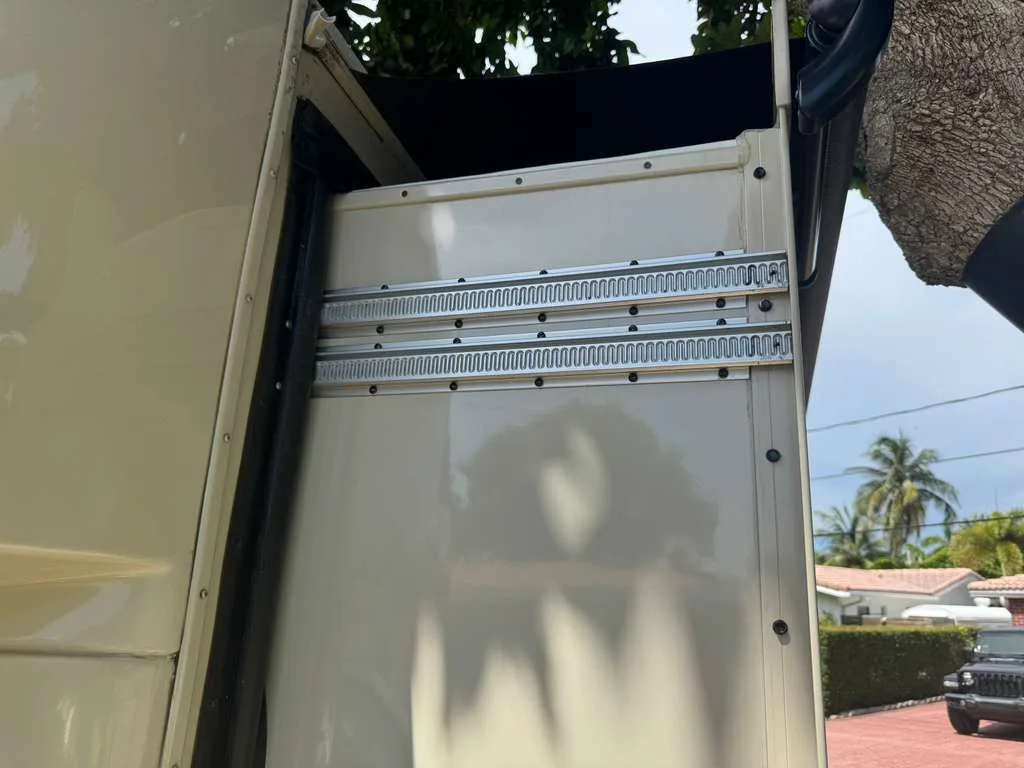
Florida's heat accelerates the wear schedule. Coaches that spend months in the sun with their rooms extended and retracted daily - at campgrounds from the Keys to the Panhandle - see rack wear years ahead of what Northern owners experience. The UV exposure alone degrades the rack composite, and the heat cycling contracts and expands the mounting rail, subtly changing the mesh alignment over time. A coach bought used from a Michigan snowbird may arrive in Florida with racks that look fine, then develop the grind within one season of daily use in a warm climate.
How the Schwintek System Actually Works
Understanding why the rack fails requires understanding the drive architecture. Each side of the slide opening has a vertical aluminum rail. A tongue-and-groove nylon gear rack is attached along the length of that rail. A small DC motor mounted at the top of each rail drives a pinion gear that engages the rack. When the controller sends a signal to extend, both motors turn simultaneously, walking the room outward along the rack. Retract reverses the direction. The controller monitors the relative position of each motor via feedback signals and stops travel if one side lags too far behind the other - this is what owners experience as the room stopping partway and refusing to move further.
The critical geometry is that the pinion dwells at the same rack sections on every cycle: the few teeth near the top of travel when the room is fully retracted, and the few teeth near the bottom of travel when the room is fully extended. Those sections see ten times the load cycles of the middle rack. They also bear the peak torque at start-of-travel, when the motor is working against inertia and the static friction of the room seals. That concentrated wear pattern is specific to the Schwintek design and is why the failure appears at the extremes rather than uniformly across the rack.
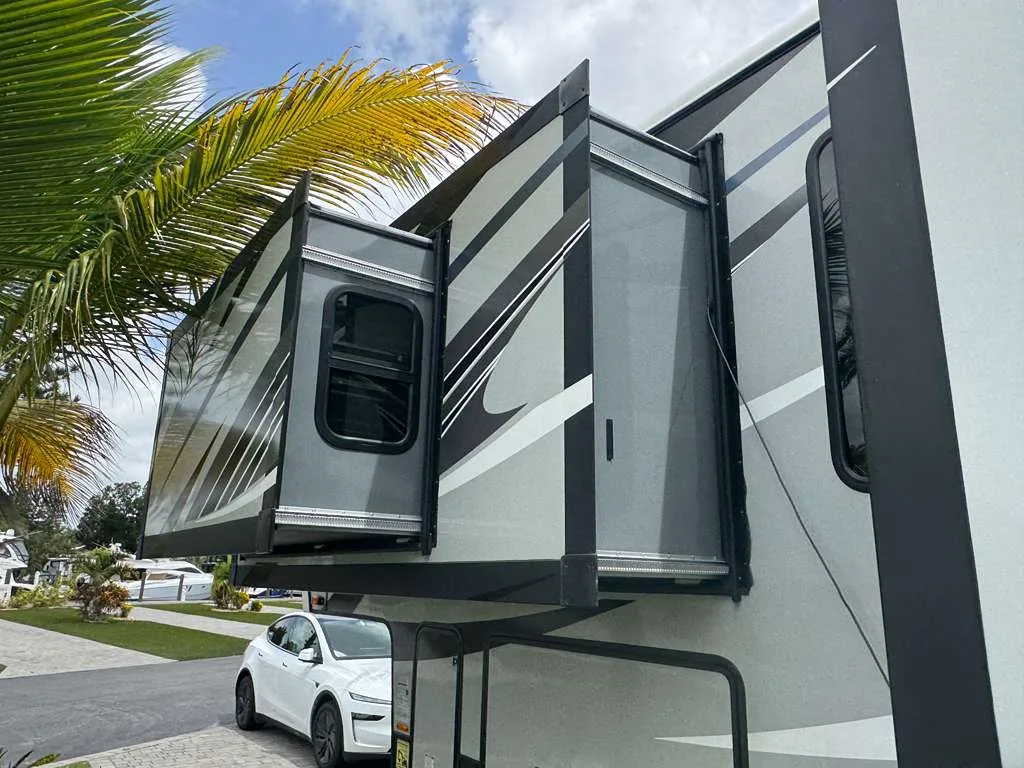
Why the Grinding Noise Points to the Rack, Not the Motor
A motor that is genuinely failing draws higher amperage, runs hot, and eventually seizes or stalls. That failure mode is quiet right up until it stops - there is no characteristic grinding sound from a motor winding down. The grinding, clicking, or chattering noise that Schwintek owners describe is the drive pinion skipping over worn rack teeth. The tooth profile has flattened or chipped enough that the pinion cannot maintain continuous engagement, so it bounces across the gap between teeth. Each skip is a small impact, and a room traveling several feet produces dozens of them in a single cycle.
The room still moves because partial engagement is enough to push it, especially mid-travel where the rack is less worn. Owners notice the noise is loudest at the beginning and end of travel - exactly the worn sections - and quieter in the middle. That pattern is diagnostic. A motor problem would produce uniform or increasing resistance throughout travel, not a noise that peaks at the extremes and quiets in the middle.
Jesse has inspected hundreds of coaches presented with the grinding complaint in which the motors tested within normal amp draw and required no replacement at all. Rack sections on both sides cost a fraction of two motors, and the repair is faster. The mistake is testing the motor first, finding it within spec, and concluding the noise must be something else. The correct sequence is to visually inspect the rack under a strong light, looking at the tooth profile on the extreme travel sections before touching the motor diagnostics at all.
The Pair Rule for Motor Replacement
When the motors do need replacing - because one has drawn excessive amperage for long enough to shorten its brush life, or because a seized rack section caused a motor to stall under load - the correct practice is to replace both motors in the same service call. This is not a parts sales tactic. It is a synchronization requirement built into the Schwintek design itself.
The two motors are matched at the factory for similar torque output and speed characteristics. When one motor is new and the other has been working for several years, their speed and torque curves diverge. The controller compensates to a point, but a significant mismatch causes the room to travel unevenly, generates a sync fault, and stops the room partway. The owner calls again, the second motor is replaced, and the room works correctly - having now paid for two service calls instead of one. Replacing motors in pairs is the approach that costs less over the life of the coach.
Manual Override: What It Actually Requires
When a Schwintek room is stuck - either fully extended and refusing to retract, or stuck mid-travel - the manual override procedure is not difficult, but it requires removing interior panels that most owners have never touched. The motor and drive assembly are hidden behind trim panels on each side of the slide opening, typically inside a closet or cabinet on each wall face. Those panels are held by screws or push-in retainer clips depending on the coach manufacturer.
Once the panels are off, the motor drive shaft is accessible. A cordless drill fitted to a socket sized for the shaft can turn each motor independently. The correct technique is to run each side in short increments - roughly six seconds at a time - alternating sides to keep the room square. Running one side fully before touching the other racks the room and can jam the rails badly enough that the manual override itself becomes impossible. The override is slow by design; the gear reduction that gives the motor its torque is working against you when you are driving it manually.
If the motor is seized rather than simply unpowered, the override does not work because the motor shaft itself will not turn. In that situation the gear rack must be disengaged from the drive pinion before the room can be moved at all. That step requires removing the motor assembly from the rail, which is a different procedure than the standard override and is not something to attempt without knowing exactly which fasteners to remove and in what order. Forcing the wrong component risks bending the aluminum rail, which changes the repair from a straightforward rack and motor job into a structural repair.
The 2010 to 2018 Coach Generation and Rack Failure Rates
The Schwintek system was introduced broadly across multiple manufacturers starting in 2010. Coaches from that first generation through approximately 2018 represent the highest concentration of rack failure calls in the field. The early rack formulations and early rail mounting tolerances were refined over those years as Lippert responded to field failures, but the coaches built in that window are now old enough that even the improved racks are showing wear.
Forest River, Keystone, Winnebago, Thor, and Coachmen all used Schwintek extensively during that period. A coach from 2012 to 2016 with one or two rooms and any history of heavy use in warm climates should have its rack sections inspected at every annual service, not just when noise appears. By the time the grinding starts, the rack has already been worn long enough that the pinion has also accumulated additional stress. Catching it at the first sign of tooth wear - a roughness in the travel that has not yet become audible - is the cheapest point in the failure curve.
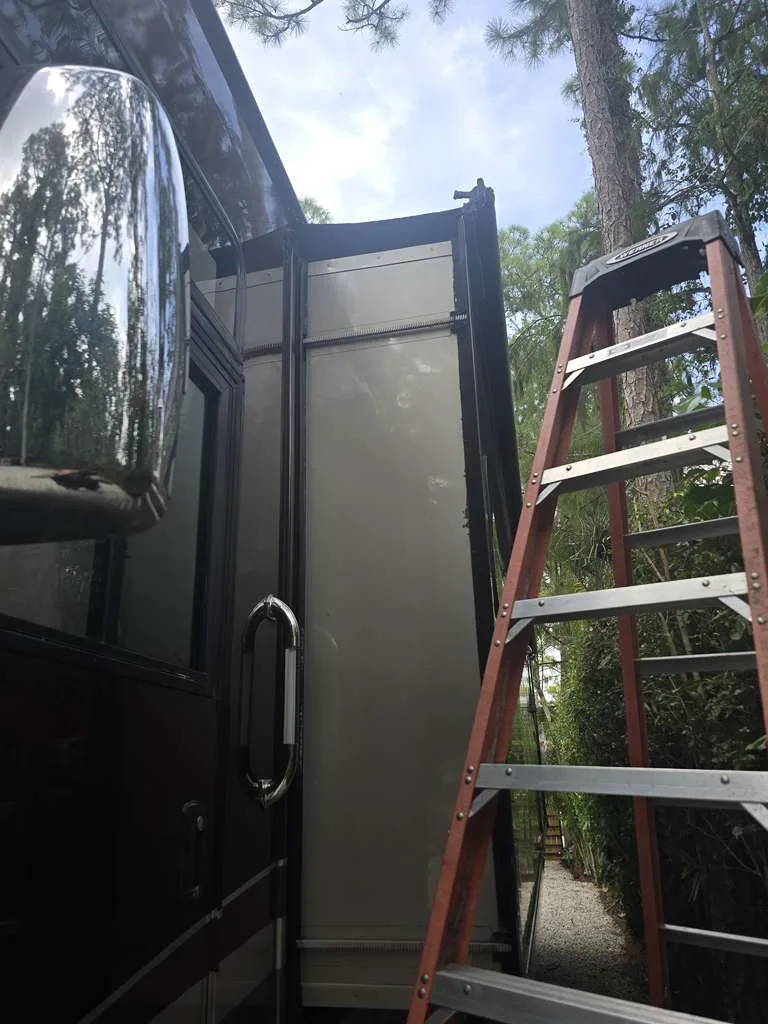
What a Schwintek Service Call Covers
A Triton RV Repair service call for a Schwintek complaint begins with a complete cycle of the room under observation, with the cover panels removed so both racks are visible during travel. Jesse watches for the skip point - the moment of disengagement - to confirm which rack section is affected and which side is primary. Amp draw on both motors is measured with a clamp meter during travel in both directions. The rail mounting fasteners are checked for torque, because a loose rail changes the mesh depth and can cause premature wear even on a healthy rack.
If the rack needs replacement, the affected sections are removed and new rack installed with the correct preload on the drive pinion. The room is cycled repeatedly after installation to confirm smooth engagement across the full travel range. If a motor is also beyond service life based on the amp draw data, it is replaced at the same visit along with its pair. The controller is reset and the room is re-synced before the panels are reinstalled. The whole call typically runs two to four hours depending on the number of rooms and whether both racks or only one side needs work.
Pricing for Schwintek Repairs in Florida
| Service | Typical Range | Notes |
|---|---|---|
| Service call + gear mesh inspection | $299 - $399 | Motor amp test and slide cycle; gear wear assessed |
| Gear rack replacement (per rail, one side) | $180 - $420 | Tongue-and-groove gear rack; most common Schwintek failure |
| Schwintek motor replacement (per motor) | $320 - $680 | Rooms typically have two; replace in pairs |
| Rail and gear set (complete room) | $650 - $1,400 | Both sides, new rack and motor; includes alignment |
| Schwintek control module replacement | $220 - $480 | If gear and motor are good but control signal is absent |
National-average pricing shown for reference. Actual costs depend on coach make, year, number of rooms affected, and parts availability at time of service. Parts supply for older Schwintek generations can affect lead time on some components.
Prices do not include travel fees for remote locations. Florida campgrounds, storage facilities, and private driveways are all serviceable by Triton RV Repair.
Frequently Asked Questions
How is a Schwintek slide different from a through-frame slide?
A through-frame slide uses a large tube or rack that passes completely through the coach wall and is driven by a motor at the center of the mechanism. The Schwintek system mounts inside the wall cavity, driving the room from vertical gear racks on each side of the opening. This makes the Schwintek lighter and allows thinner walls, but it means the load is carried at the perimeter rather than the center, and the rack teeth at each end of travel take concentrated stress every time the room moves.
What is the grinding noise my Schwintek room makes on retract?
In the large majority of coaches built between 2010 and 2018, that sound is worn gear rack teeth, not motor failure. The tongue-and-groove rack degrades fastest at the extreme travel positions - the fully extended and fully retracted points - because that is where the drive pinion dwells and applies peak torque on every cycle. Once those teeth are worn enough to skip, the motor sounds strained and the room shudders. Replacing the motor without addressing the rack produces the same sound within a season.
Can Schwintek gear racks be repaired or do they always need replacing?
Replacing is the correct answer in almost every case. The racks are a precisely machined plastic composite, and once the tooth profile is worn the engagement geometry is gone. Lubricating worn rack teeth quiets the noise temporarily but accelerates wear on the drive pinion and the motor brushes. A new rack section is the repair; everything else is a delay.
Why does my Schwintek room go in but not come all the way out?
This is usually a sync fault between the two motors rather than a mechanical blockage. Each side of the room has its own motor, and the control module monitors their relative position. When one side lags - because of a worn rack section, a stiff roller, or a weak motor - the module stops travel to prevent racking the room. Clearing the fault often requires cycling the slide with the cover panels removed so each side can be inspected under load. A rack replacement on the lagging side usually resolves it permanently.
How do I manually retract a Schwintek slide if the motor fails?
The Schwintek manual override requires removing the interior cover panels on each side of the slide opening to expose the gear racks. Most coaches have two or three trim panels held by screws or push clips. Once the racks are visible, a hand drill or ratchet fitted to the motor drive shaft can turn each motor independently. Work both sides in short equal increments to keep the room square. Do not use an impact driver - the torque can strip the drive coupling. If the motor is seized rather than just unpowered, the rack must be disengaged first, which requires a technician.
Sources and Further Reading
The technical specifications for Schwintek gear rack dimensions, motor replacement procedures, and manual override instructions are documented by Lippert Components, the system's manufacturer. Their resource library includes torque specifications for rail fasteners and amp-draw thresholds for motor service evaluation.
Source: Lippert Schwintek system documentation - Schwintek in-wall gear specs, motor replacement procedure, and manual override instructions.