Mobile RV Hydraulic Slide-Out and HWH System Service Across Florida
Hydraulic slide systems are on older Class A coaches and most HWH-equipped rigs. They are powerful and reliable when maintained but develop specific failure modes - leaking cylinders, failing solenoids, and low fluid - that require hydraulic knowledge to diagnose correctly.
An HWH hydraulic slide system uses Dexron III ATF as its working fluid - not dedicated hydraulic jack oil and not power steering fluid. A slide that creeps slowly inward overnight while parked is almost always a solenoid valve that is not seating fully against its port, not a low-fluid condition. These two facts together explain why the most common first responses to hydraulic slide problems - topping off the reservoir, or assuming a cylinder seal is blown - are frequently wrong, and occasionally make things worse.
How is a hydraulic slide system different from an electric one?
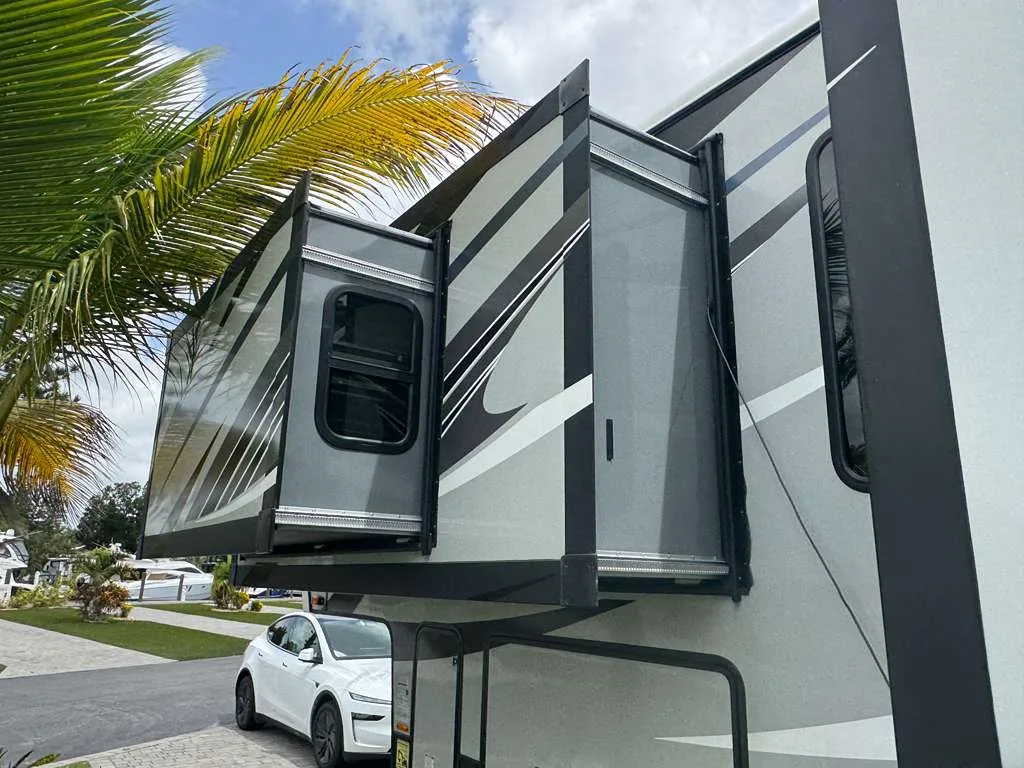
The distinction matters for diagnosis because the two systems fail completely differently and share almost no components.
An electric slide uses a gear motor, a rack-and-pinion assembly, or a cable-drive mechanism to move the room directly. Power goes in, mechanical motion comes out. The troubleshooting path is electrical first - check the motor, the switch, the limit switches, and the wiring before assuming anything mechanical has given out.
A hydraulic slide moves its room using fluid pressure. A pump motor pressurizes Dexron III ATF in a reservoir, solenoid valves route that pressure to one side of a ram cylinder, and the cylinder extends or retracts to drive the room. When the slide reaches its limit, the solenoids close, and the fluid pressure trapped in the cylinder holds the room in position. That last detail is what makes HWH systems vulnerable to the creep symptom - anything that lets pressure slowly escape will let the room move.
The hydraulic approach delivers more force than most electric systems, which is why it became standard on heavy-duty Class A diesel pushers from the late 1990s through the 2000s. Coaches like the Monaco Dynasty, Tiffin Allegro Bus, Newmar Mountain Aire, and most Prevost conversions from that era came with HWH or a competing hydraulic system. The extra force matters when you are moving a slide room that weighs several hundred pounds and has been sitting in Florida sun long enough for the wiper seals to stiffen.
What fluid goes into an HWH hydraulic system?
Dexron III ATF, and the reason it is not interchangeable with other hydraulic fluids is specific enough to be worth understanding before anything is added to the reservoir.
HWH designed the seal compounds in their cylinders and valve bodies around the viscosity and additive package of Dexron III. The seals are compatible with that fluid and have known longevity with it. Substitute a generic hydraulic fluid - even one with a similar viscosity rating - and the additive mismatch begins degrading the seal elastomers. You will not see the problem immediately; you will see it six to eighteen months later as a cylinder that now weeps at the ram.
Generic hydraulic jack oil, which is what many owners reach for at a hardware store, has a completely different additive package and is not a suitable substitute regardless of the viscosity grade printed on the bottle. Power steering fluid is also incompatible, despite being ATF-adjacent in some formulations. The correct answer is Dexron III or a fluid specifically approved in the HWH service manual for the AP44929 system or the Level-Plus system on your coach.
Florida adds one more consideration. The fluid expands as it heats up, and a reservoir filled to the full mark at 70 degrees Fahrenheit will be over the full mark after an afternoon in direct sun with the slides extended. HWH systems have a pressure-relief valve that protects against overpressure, and a reservoir that is slightly too full will vent through it. That produces what looks like a fluid leak near the pump - fluid on the floor of the bay, no obvious seal failure - when the actual problem is that the system is self-correcting a minor overfill. The fix is to check the fluid level with the coach at operating temperature and the slides fully retracted, which is the condition specified in the HWH service manual.
Why does a hydraulic slide creep when the coach is parked?
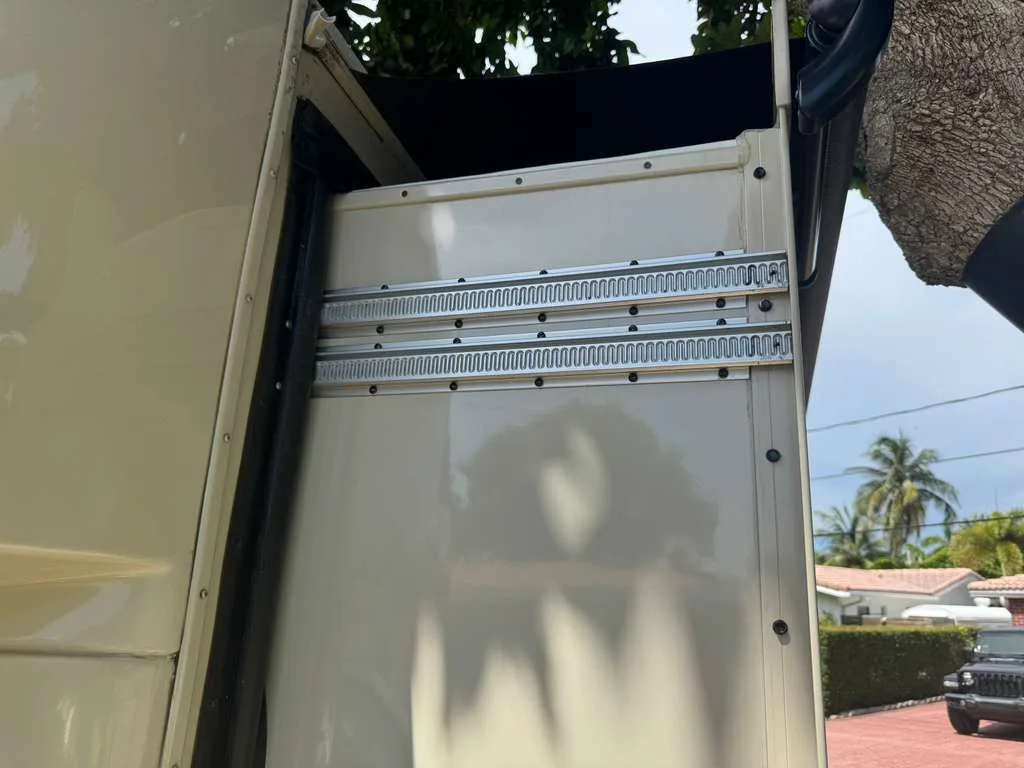
Creep - a slide room that is out when you go to bed and noticeably retracted by morning - is almost always a solenoid valve that is not holding a clean seat against its port.
When a slide reaches its extended position and the switch is released, the solenoids that were routing pressure to the extend side of the cylinder close. The fluid trapped in that side of the cylinder is what holds the room out. If one of those solenoids has debris on its seat, a worn plunger, or a coil that is not pulling the plunger fully home, it does not seal completely. Fluid bleeds slowly from the high-pressure side of the cylinder back into the return line. The room follows.
The owner's instinct is to check the fluid level and add some if it looks low. That addresses nothing mechanical, and in a well-sealed system it should not even be low - the fluid has not gone anywhere external, it has just moved to the wrong side of the valve. Adding fluid to a system with a bad solenoid accomplishes nothing except moving the overflow problem forward in time.
A cylinder seal failure produces a different symptom. When the ram seal blows, fluid escapes externally, which means there is a puddle or a wet trail visible in the slide bay. The room may also fail to hold any position under load rather than slowly creeping over hours. Those two symptoms together - external leak and inability to hold under load - point toward a cylinder. Slow overnight drift with no visible external leak points toward a solenoid. The distinction matters because the repair cost and labor are substantially different.
How do you manually retract a hydraulic slide in an emergency?
The procedure depends on which HWH system is installed, and doing this incorrectly can trap a slide in an intermediate position, so it is worth knowing the distinction before anything fails on the road.
Some HWH systems - particularly the older AP44929 platform common on coaches from the 1990s - have a manual hand pump integrated into the hydraulic panel. The pump is typically accessed through a small access panel in the main slide bay, identified by a T-handle or a small rubber-capped port. Connecting the hand pump and cycling it builds manual pressure that can activate the solenoid-controlled circuit, allowing the slide to be cycled without the electric pump motor. This approach works when the failure is in the motor or the electrical supply to it, but not when the solenoid valves themselves have lost power or have failed mechanically.
On systems without a hand pump, the alternative is to manually open the solenoid valve using the override fitting that HWH installs on most valve bodies. Opening the solenoid allows fluid to flow freely, and on the retract side, the room's own weight combined with the return spring in the cylinder will drive it back in. This is done with a wrench or a proprietary override tool, and the sequence is coach-specific - opening the wrong valve in the wrong order can produce unintended movement. We carry the service procedures for the most common HWH configurations on our trucks, and this is a job where having the right documentation matters more than having the right tools.
If neither approach is available and the slide is partially extended on a coach that needs to move, the stop-gap is to support the extended room with a slide-out stabilizer and drive only the distance needed at low speed, then address the hydraulic system before moving again. Driving with a fully extended slide is a structural and legal problem on a Florida highway.
What causes an HWH system to lose pressure between uses?
There are two distinct failure modes and they point in different directions, so separating them on the service call saves significant labor time.
The first is internal bypass. The system holds pressure while operating - the pump builds it, the slide moves normally - but the room drifts between uses. This is the solenoid pattern described above. The fluid has not gone anywhere external; it is slowly crossing a valve seat it should not be crossing. A pressure test performed immediately after cycling the slide, with the pump off, shows pressure that then slowly falls over the next thirty to sixty minutes. That confirms internal bypass without opening anything.
The second is external loss. Fluid is escaping through a cylinder seal, a fitting, a hose, or the pump motor shaft seal. This produces a visible puddle or wet area and a system that is losing fluid volume over time. The reservoir level drops measurably between uses rather than staying stable. External leaks are found by a systematic visual inspection with the coach at operating pressure - hydraulic seals under pressure will weep where a cold system at rest may look dry.
Florida heat sharpens both failure modes. Internal bypass becomes more pronounced as the fluid thins at high temperature. External leaks grow worse as thermal cycling works the seal materials. Coaches that park in direct sun for months at a time often develop problems at cylinder rod seals specifically because the rod is exposed to UV and heat while the cylinder body stays cooler, and that differential produces a small amount of rod movement each day that wears the wiper seal over time.
Is a hydraulic slide better or worse than an electric slide for reliability?
Neither is inherently more reliable - they are reliable in different ways, against different failure modes, at different cost points for repair when something does go wrong.
Hydraulic systems are mechanically simple at the actuator end. A ram cylinder has a rod, a couple of seals, and an end cap. There are no gears, no rack-and-pinion teeth to wear, no cables to stretch or break. The failure modes in the cylinder itself are limited to seal leakage, which is diagnosable and repairable at the coach. The complexity lives in the pump, the solenoid manifold, and the fluid condition - and those require hydraulic knowledge rather than just electrical troubleshooting to diagnose correctly.
Electric slide systems have more components at the drive mechanism - motors, gears, limit switches, cables or racks - but the electrical diagnostics are more accessible to owners and most RV technicians. An electric motor that has seized or a limit switch that has failed is a more immediately diagnosable problem than a solenoid valve with marginal seating that only shows itself as slow overnight creep.
For coaches from the 1990s and early 2000s that came with HWH hydraulics, the correct answer is to maintain the hydraulic system properly rather than wish it were electric. The systems were engineered for heavy rooms and long service lives. Most of the HWH failures we see across Florida are maintenance-deferred problems - wrong fluid, overfilled reservoirs, neglected solenoid filters, cylinder seals that could have been caught early if the bay was inspected annually. A well-maintained HWH system on a coach that gets used regularly will outlast the coach itself.
What does a full HWH service call actually cover?
A diagnostic visit for a hydraulic slide problem covers four things in sequence, and the sequence matters because each step tells you what to look for in the next.
The first is a fluid condition check - level, color, and smell. Dexron III ATF should be translucent red or pink. Fluid that has gone dark brown, smells burned, or has a milky appearance from water contamination needs to come out regardless of whatever else is found. Contaminated fluid damages valve seats and seals faster than anything else in the system.
The second is a pressure test. The pump is run and system pressure is measured at the manifold. HWH specifies operating pressure for each system, and a pump that cannot reach it is either worn internally or has a relief valve that is opening too early. A pump that reaches spec but the pressure decays immediately when the pump stops is pointing toward internal bypass.
The third is a solenoid function check. Each solenoid is tested individually - activated, confirmed to hold, then released and confirmed to seat. A solenoid that activates but does not fully seat is the most common finding on a creeping slide.
The fourth is a cylinder inspection with the slide extended under pressure. Visible weeping at the rod seal under working pressure is different from a dry rod at rest. This inspection requires the slide to be out and the system at pressure, which means it cannot be done at a storage lot without tools and a power source. We bring a generator on hydraulic calls for exactly this reason.
What Does Mobile RV Hydraulic Slide Service Cost?
These are typical ranges for mobile service across Florida. The Notes column explains what each line item includes.
| Service | Typical Range | Notes |
|---|---|---|
| Service call + pressure test | $299 - $399 | Fluid level check, solenoid function test, full slide cycle |
| Hydraulic fluid flush and refill | $145 - $285 | Dexron III or HWH-specified fluid; full system bleed |
| Cylinder seal replacement (per cylinder) | $280 - $680 | Ram seals; in-place or room removal depending on access |
| Solenoid valve replacement | $200 - $550 | Single valve; HWH AP44929 system |
| HWH pump motor replacement | $480 - $1,100 | Complete pump assembly |
Service call (trip charge + first hour) is $299-$399 depending on location - confirmed when you book. Repair line items reflect mobile labor plus parts for common HWH AP44929 configurations. National averages for mobile service (2025 data). Call (888) 702-6880 for an exact quote on your coach.
Questions owners ask us about hydraulic slide systems
How is a hydraulic slide different from an electric slide?
A hydraulic slide moves its room using fluid pressure generated by a pump motor that pressurizes Dexron III ATF through solenoid-controlled valves and into a ram cylinder. An electric slide uses a gear motor or a rack-and-pinion mechanism driven by electricity directly. The hydraulic system delivers more force and is common on heavy Class A diesel pushers from the 1990s and 2000s. Electric systems are simpler to diagnose but can struggle with a heavy room that has shifted or has binding seals.
What fluid does an HWH hydraulic system use?
Dexron III ATF, or the HWH-specified equivalent. Not dedicated hydraulic jack oil, not power steering fluid, and not any generic hydraulic fluid. HWH engineered their seals and valve seats around the viscosity and additive package of Dexron III, and substituting a different fluid degrades those seals over time. When we flush and refill an HWH system we use the correct specification, and we bleed the circuit completely to remove air.
Why does my hydraulic slide creep in or out when parked?
Almost always because a solenoid valve is not seating cleanly and is allowing fluid to bypass slowly from the high-pressure side of the cylinder to the return line. Creep is not a low-fluid symptom. If the room were losing fluid externally, you would see a puddle under the bay. Slow retraction or extension while the pump is off is a valve issue, and adding fluid will not stop it.
How do I manually retract a hydraulic slide in an emergency?
Some HWH systems have a hand pump integrated into the hydraulic panel, usually accessible behind a small panel in the bay area. Pumping it builds manual pressure and can cycle the slide if the solenoids are still functional. On systems without a hand pump, the alternative is manually opening the solenoid valve with a wrench or override tool, which allows the room's own weight and the return spring to pull it in. This is coach-specific and the service manual should be checked before attempting it. We carry the procedures for the most common HWH AP44929 systems on our trucks.
What causes a hydraulic system to lose pressure between uses?
In most cases a valve is allowing slow internal bypass. External leaks at cylinder seals or fittings are the other cause, and those leave visible evidence in the bay. A system that holds pressure during operation but bleeds down while parked is pointing at a solenoid. A system that loses pressure while running is pointing at the pump or a cylinder seal. Florida heat adds a complication: hot fluid expands, and a slightly overfilled reservoir will vent through the pressure-relief valve, which looks like a leak but is the system protecting itself.
Sources
- HWH hydraulic system service manuals - AP44929 and Level-Plus schematics, fluid specs, and cylinder service procedures.