Mobile RV Roof Vent Lid and Skylight Replacement Across Florida
A cracked vent cover is the smallest water entry point that causes the largest downstream damage. Florida UV cracks plastic within a few years, and a broken vent lid in rain season is a direct path into the decking below.
Most RV vent lids are molded from ABS (acrylonitrile butadiene styrene), a thermoplastic that absorbs UV radiation rather than reflecting it. Under sustained subtropical sun, the UV energy cross-links the polymer chains, reducing the material's impact resistance and elongation at break. The lid does not soften - it becomes progressively more brittle, from the surface inward, until a hinge flex or a hailstone that would have barely scratched it new now shatters it. Polycarbonate lids, used on premium units like MaxxAir ventilators, handle UV very differently: they contain a UV-absorbing co-extrusion layer that sacrifices itself slowly without the bulk of the material embrittling. The difference is why a polycarbonate lid might last twelve years on a Florida roof while a standard ABS lid from the same coach may crack before the fourth anniversary.
Why do RV vent lids crack so quickly in Florida?
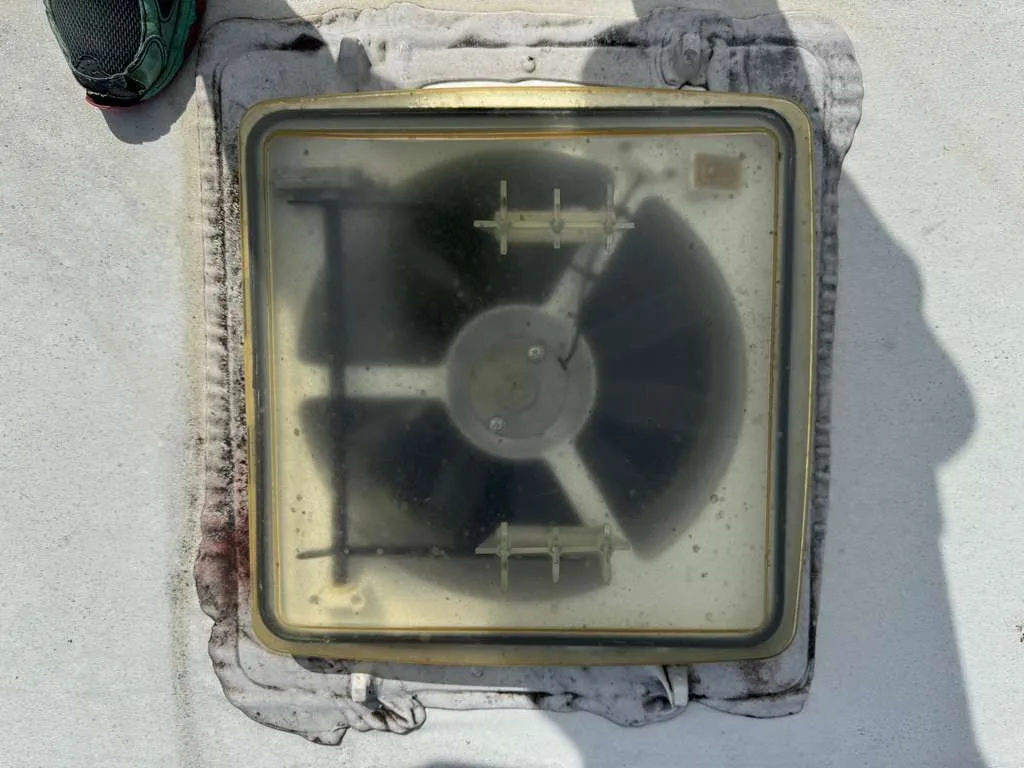
Because ABS plastic and continuous UV exposure are a poor combination, and Florida delivers more UV hours per year than almost anywhere else in the continental United States.
The failure mode is not fading or warping - it is internal embrittlement that is invisible until a stress is applied. The hinge is almost always where the crack starts, because it concentrates bending stress every time the lid is opened or buffeted by wind. A lid that feels solid when you press on it can still shatter at the hinge if you open it too quickly on a cold morning after a night of low temperatures, because ABS is notch-sensitive and its glass transition temperature means that even Florida winters can bring it temporarily into its brittle range before sunrise.
The two-to-three-year failure window is consistent enough that we treat it as a maintenance interval on older coaches: if the lid is original equipment and the coach spent its life in Florida, the question is not whether it will crack but when. Replacing a lid proactively before rain season costs a fraction of what it costs to dry out decking that has been getting dripped on through a split lid for three months.
Can I replace just the lid without replacing the whole vent frame?
Usually yes - and in the majority of cases that is the correct repair.
The vent base is a separate piece from the lid. On a standard 14x14 vent, the base is bedded into the roof membrane and fastened through it, and then the lid snaps or pins onto the base. As long as the base is structurally intact, its mounting screws are not pulling out, and the sealant around its perimeter is holding, only the lid needs to change.
The practical check before confirming a lid-only swap is to look at the frame closely and press around its perimeter. A base that rocks, that shows UV-induced craze cracking of its own, or that sits on sealant that has gone hard and pulled away at the edges needs to come out with the lid. Leaving a failing base under a new lid resets the clock for the lid while guaranteeing the frame problem continues.
If the inspection reveals soft decking around the base - which happens when a cracked lid has been leaking through a season or two - that changes the scope entirely. The frame comes out, the damaged decking is addressed, and then the area is properly prepared before a new unit goes back in. That is the roof repair service rather than a simple lid swap, and the cost difference is substantial, which is exactly why identifying the situation at the outset matters.
What is the difference between a Fantastic Fan, a MaxxAir vent, and a standard manual vent?
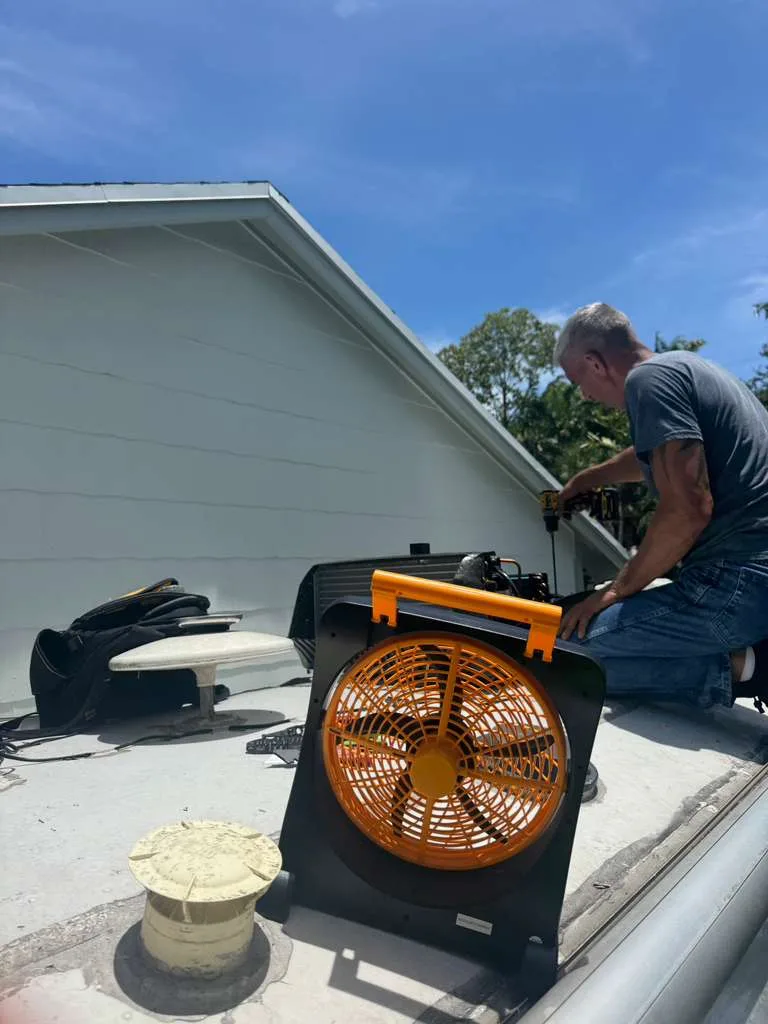
They are three different categories of product that happen to share an opening size, and confusing them at the parts store is how owners end up with a component that does not fit.
A standard manual vent - from Ventline, Elixir, or Camco - is a static lid on a hinged base. It opens by hand, stays in position by friction or a prop rod, and provides ventilation only when physically propped. The lid is the only part that fails routinely; the base typically outlasts several lid replacements. These are the simplest and least expensive units and the right answer for a galley or bathroom vent where powered airflow is not needed.
A Fantastic Fan is a powered vent with a motor-driven fan blade. The lid still opens by hand, but the fan runs on 12-volt DC and can reverse direction - pulling air out of the coach or pulling cooler outside air in, depending on the conditions. Fantastic Fan units are quiet at low speed, which is why they are popular for sleeping areas. The cover is always polycarbonate, which is part of why these units survive Florida UV better than OEM lids on the same coach.
A MaxxAir ventilator - the MaxxFan line - goes a step further: the lid opens and closes electrically, meaning it can be operated without going on the roof and, critically, it can be left partially open during rain because the raised lid deflects water. MaxxAir units generally move more CFM at their higher speed settings and are the right choice when serious ventilation is the goal. The powered lid also means they can close automatically via the included remote when a storm rolls in, which a Fantastic Fan cannot do without an add-on accessory.
None of the three bases is interchangeable with the others. A Fantastic Fan sits in its own proprietary trim ring; a MaxxAir has its own mounting collar and wiring harness. Converting from one type to another is a full unit replacement, not a lid swap, and it involves routing 12-volt wiring to the unit if one was not already there.
How do I know which replacement lid fits my existing base?
By the base manufacturer and the hinge style, not by measuring the opening.
Nearly every vent in an RV uses a 14x14 rough opening, so measuring the hole tells you almost nothing useful. What identifies the lid is the hinge pin diameter, the snap-clip pattern at the corners, and which brand molded the base. Ventline and Elixir bases accept their own respective replacement lids, and while many replacement lids are marketed as universal, the fit at the hinge and clips varies enough that using the wrong one produces a lid that rattles, gaps at one corner, or breaks at the hinge within a season because the geometry is slightly off.
The easiest identification method is to read the molding stamp on the inside of the existing base - it almost always names the manufacturer - or to photograph the hinge detail and look it up against the manufacturer's current catalog. We do this identification step before ordering parts on any lid replacement, because shipping back a wrong part adds a week to the job and the owner is without a sealed vent in the meantime.
Skylight replacements follow the same logic but are less standardized. Skylight frames come in more sizes than vent frames, and the lens profile - whether it is a double-dome, a flat lens, or a single-dome - determines the part. A cracked skylight lens on a sound frame is a lens-only replacement; a frame that has cracked or whose mounting flange has separated from the roof means the whole unit comes out, which again requires checking the decking underneath before the new one goes in.
Is a cracked vent lid an emergency or can it wait?
The answer is entirely determined by the size of the crack, whether any part of the lid has separated, and what the weather calendar looks like.
A hairline crack at the hinge with no gap, discovered in January on a coach that is stored covered, is a scheduling item rather than an emergency. The crack is not letting water in, and it will not get worse sitting covered through the dry season. It goes on the list for the next service visit and gets done before June.
A crack with an open gap is different. A gap that is even a few millimeters wide during Florida's June-through-September rain season allows water to enter every time it rains, which in central and south Florida means most afternoons. The water follows the path of least resistance from the vent opening down through the roof decking, and once the decking is wet it does not dry quickly - Florida's humidity prevents it. Wet decking begins to delaminate in a matter of weeks, and a delaminated section cannot simply be dried out and re-covered. It has to be replaced, which is several hundred to several thousand dollars of additional work depending on how far the damage has spread.
The math is straightforward: a lid replacement costs between $65 and $310 depending on whether it is a standard lid or a complete powered unit. Decking repair in a section around a vent costs $600 to $2,200. The case for treating a split lid as urgent before rain season is not a sales pitch - it is the actual cost relationship.
Should I upgrade to a powered vent when replacing a manual one?
In Florida, the upgrade is worth considering seriously, and the payback is faster than it looks on paper.
A manual vent does one thing: it creates an opening. Air moves through it only by convection or wind, and in a parked coach on a still Florida afternoon that means very little movement. The interior can reach temperatures that accelerate delamination of cabinetry, off-gas compounds from adhesives and fabrics, and make the time before shore power is connected genuinely unpleasant.
A powered vent running on 12-volt power moves 900 to 1,500 CFM depending on the unit - enough to exhaust the full air volume of a typical coach interior several times per hour. That air exchange does three measurable things: it drops interior temperature faster after arrival, it removes moisture-laden air before it condenses on surfaces, and it reduces the runtime of the air conditioner once the coach is cool because the interior heat load has been mechanically removed rather than allowed to accumulate.
The electrical draw of a Fantastic Fan or MaxxAir on low speed is 1 to 2 amps - trivial against a coach battery bank or even a solar setup. The fan pays for itself in reduced generator hours during the periods between hookup. For a coach that sits parked for weeks at a time in Florida storage, a powered vent running on a timer is also the standard recommendation for preventing the mildew that forms inside fully sealed, stagnant coaches.
The upgrade from a standard manual lid to a complete Fantastic Fan or MaxxAir unit runs $120 to $310 in parts, plus the service call. It is a reasonable decision to evaluate any time the coach needs a lid replacement anyway - adding the cost of a complete unit to a visit that is already happening is considerably cheaper than scheduling a separate install later.
How do we identify which replacement lid fits and what the decking looks like?
The service call starts on the roof, not with a parts catalog.
Before we confirm any parts, we inspect the existing base for structural integrity, read the manufacturer stamp, and check the sealant perimeter with a probe. A moisture meter reading around the vent penetration tells us whether the decking below is dry or has already taken water - a reading that matters enormously for the scope and cost of the job.
If the decking is dry and the base is sound, the lid swaps in one visit. If the decking shows elevated moisture, we discuss the extent of the repair before ordering anything, because proceeding with a lid-only swap over wet decking leaves the underlying problem and means the decking continues to deteriorate under a new lid. That is the kind of repair we do not want to do to a coach, and we tell owners plainly when the honest answer requires more work than they called for.
Most lid replacements are completed in the first service-call hour. The frame-and-decking scenario adds time, and we will quote that separately once we know what the moisture readings show. Scheduling in advance of rain season - before May in south Florida, before June further north - gives us the best chance of a straightforward job rather than a repair that has expanded because water has been sitting in the decking for months.
What Does RV Vent Lid and Skylight Replacement Cost in Florida?
These are typical ranges for mobile service across Florida. The Notes column describes what each line item covers.
| Service | Typical Range | Notes |
|---|---|---|
| Service call + vent inspection | $299 - $399 | Includes inspection of all roof penetrations; most replacements complete in first hour |
| Standard vent lid (14x14) | $65 - $145 | Ventline, Elixir, or Camco; keyed to existing base |
| Fantastic Fan complete vent assembly | $120 - $280 | Fan, lid, and trim ring if needed |
| MaxxAir ventilator replacement | $135 - $310 | MaxxFan or Maxxair Turbo; wired installation |
| Skylight lens replacement | $95 - $220 | Dome only if frame intact, or full unit with frame |
Service call (trip charge + first hour) is $299-$399 depending on location - confirmed when you book. Part and labor estimates above are for the replacement work after the service call. Decking repair, if moisture readings indicate it is needed, is quoted separately on site. Call (888) 702-6880 for an exact quote.
National average pricing data sourced from 2025 mobile RV service cost surveys. Prices vary by coach size, location, and whether the frame or decking requires work in addition to the lid.
Vent and skylight questions owners ask us
Why do RV vent lids crack so quickly in Florida?
Because most OEM vent lids are molded from ABS plastic, which absorbs UV energy rather than reflecting it. In Florida's subtropical sun the material becomes brittle from the inside out over two to three seasons. The crack almost always starts at the hinge or a corner - the points of highest stress - and the lid looks fine until it does not.
Can I replace just the lid without replacing the whole vent frame?
Usually yes, provided the base and the sealant around it are sound. Replacement lids for 14x14 frames from Ventline, Elixir, and Camco are widely available and key directly to existing bases. The only reason to pull the frame is if it is cracked, the sealant around it has failed, or the decking underneath has taken water. We check the frame and its seal before confirming which part is needed.
Is a cracked vent lid an emergency or can it wait?
It depends on the size of the crack and the season. A hairline at the hinge in December poses little immediate risk. A split lid with a gap, heading into Florida's June-through-September rain season, is a direct water path into the decking and should not wait. Decking repair costs ten to twenty times what a lid replacement costs, so the math on urgency is straightforward.
What is the difference between a Fantastic Fan and a MaxxAir vent?
Both are powered vent fans, but they are built around different assumptions. Fantastic Fan units use a reversible motor so the fan can pull air in or exhaust it, and their covers open by hand. MaxxAir ventilators - the MaxxFan line - have powered lids that open and close electrically and can run in rain with the lid raised. MaxxAir units tend to move more CFM at higher speeds; Fantastic Fan units are typically quieter at low speed. Neither fits the other's base, so the replacement has to match or the frame comes out.
Should I upgrade to a powered vent when replacing a manual one?
In Florida, almost always yes. A manual vent lid is a static piece of plastic that provides ventilation only when propped open. A powered unit moves measurable airflow on demand, can be closed remotely when a storm rolls in, and reduces interior heat load enough to cut the time the air conditioner runs. The upgrade pays back in reduced generator or shore-power hours over a Florida summer.
Sources
- Fantastic Vent product line - Fan models, lid compatibility, and installation dimensions.
- Maxxair ventilator specs - MaxxFan Deluxe and Plus dimensions, wiring requirements, and base compatibility.