Mobile RV AC Coil Cleaning Across Florida
A dirty condenser coil is the cheapest problem that kills the most cooling capacity. In Florida, pollen, cottonwood, road grime, and salt pack the fins within one season.
A blocked condenser coil raises the refrigerant's condensing pressure, which forces the compressor to work against a higher head pressure - shortening its life long before it actually fails. In Florida's mix of cottonwood season, coastal salt aerosol, and year-round UV heat load, one season of neglected coils costs more in compressor wear than a decade of annual cleaning services. Triton RV Repair dispatches to your campsite, driveway, or storage lot across Florida to clean both the condenser and evaporator coils, comb bent fins, wash filters, and verify the unit's temperature split before leaving.
Why Florida Coils Foul Faster Than Anywhere Else
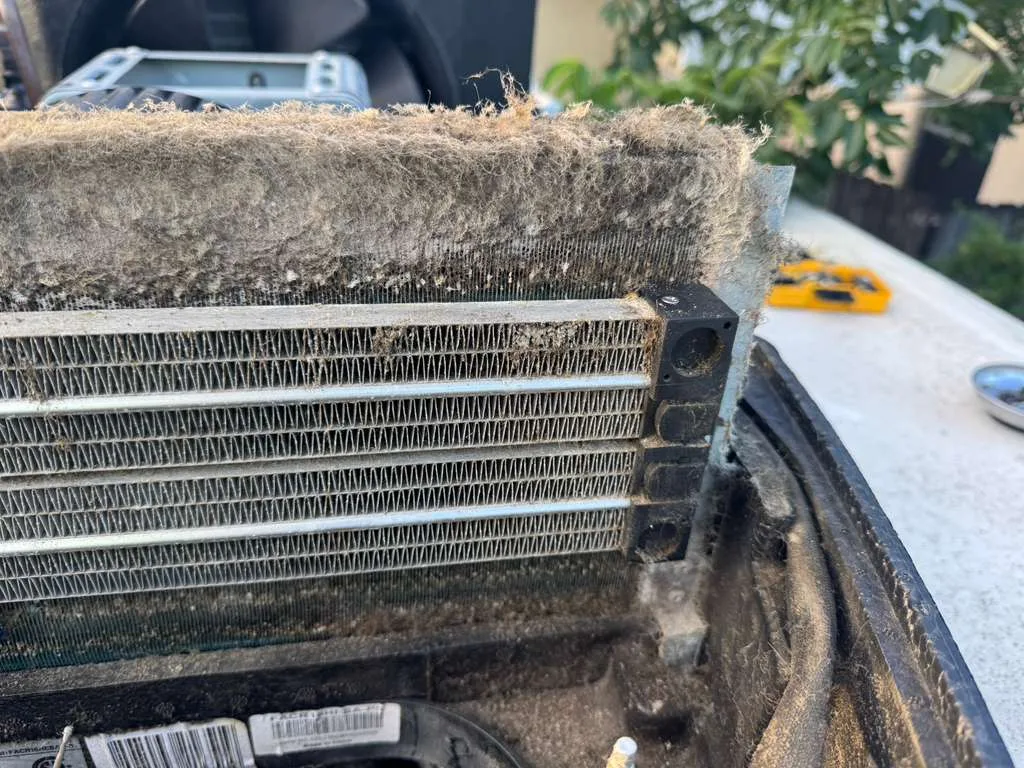
Florida imposes a combination of fouling stresses that no other continental state matches. From February through May, live oaks and cabbage palms shed pollen in quantities that coat every horizontal surface in a yellow-green layer within days. Cottonwood fluff from surrounding vegetation follows immediately after, and the humidity that characterises the Florida climate causes pollen particles to bond to the metal fins rather than blow off in the next breeze. By early summer the condenser fin pack on a rooftop unit can resemble a felt mat - continuous, dense, and almost completely impermeable to airflow.
The coastal dimension compounds the problem. Coaches parked or stored within a few miles of the Atlantic or Gulf coast are bathed in salt aerosol around the clock. Salt does not merely accumulate on the fin surfaces the way pollen does; it corrodes the aluminum alloy that fins are made from, roughening the surface at a microscopic level and creating more sites for subsequent fouling particles to attach. A coach that spends a season near the coast and is not cleaned promptly will show measurable fin corrosion at the trailing edges within twelve to eighteen months. Once fins corrode and stiffen, they cannot be straightened as cleanly, and the surface roughness permanently increases the unit's fouling rate. Cleaning early and often is the only way to interrupt that cycle.
What Happens Inside the Unit When the Coils Are Blocked
The condenser coil's job is to transfer the heat that the refrigerant has absorbed from the cabin into the outside air. When fins are blocked, less air moves across the coil surface per minute, so the refrigerant cannot shed heat efficiently and exits the condenser still carrying more thermal energy than it should. The compressor then has to compress this warmer, higher-pressure refrigerant to achieve the same condensing effect - it works harder, runs hotter, and draws more current for every hour it operates. On a Florida summer day where ambient temperatures on the roof can reach 120 to 130 degrees Fahrenheit, a unit with a 25 percent blocked condenser is already near the upper limit of what the compressor can safely handle. Add another 25 percent blockage and the thermal overload protection trips, shutting the unit down entirely until it cools.
The evaporator side carries its own risks. The evaporator coil inside the ceiling box collects airborne dust, mold spores, and condensate residue continuously. A light coating of biological growth on the evaporator fins insulates the coil surface and reduces the rate at which the refrigerant can absorb heat from the cabin air. The practical result is that the air coming out of the vents feels less cold than it should for the thermostat setting, and the unit runs longer cycles trying to compensate. Longer cycles mean more hours of compressor operation per day, more power draw from the shore hookup or generator, and a faster approach to the end of the compressor's service life. A thorough evaporator clean - which requires accessing the interior ceiling box - restores the coil's full heat-absorption surface and immediately improves the temperature split that a technician can measure across the air handler.
The Cleaning Process: What Triton Does On-Site
Jesse Marcer has been servicing RV air conditioners in Florida since Triton RV Repair opened in 2014, and the coil cleaning process reflects what a decade of RVIA-certified work in this climate actually demands. On the condenser side, the roof shroud cover is removed and the fin pack is inspected for the type of fouling present - dry pollen foul, compressed cottonwood mat, or salt-bonded corrosion debris each respond better to different approaches. Dry fouling is blown from the inside out first to avoid driving debris deeper into the fin pack, then the coil is rinsed with a low-pressure flow in the same direction the fan draws air. Bent fins are straightened with a fin comb to restore the designed fin spacing, which is as important for airflow as removing the debris itself.
Inside the coach, the evaporator ceiling box cover is removed and the coil surface is treated with a foaming coil-safe cleaner that penetrates the fin pack and breaks down biological films without damaging the aluminum. The condensate drain and pan are cleared of any accumulated debris that would otherwise back up into the unit during high-humidity operation. After both coils are clean, the air filter - typically a foam or fiberglass pad that sits between the ceiling grille and the evaporator - is washed or replaced. With everything reassembled, Jesse runs the unit at full cooling and measures the temperature split between the return air entering the ceiling box and the supply air coming out of the vents. A properly clean and functional unit should show a split of 16 to 22 degrees Fahrenheit; anything outside that range points to a follow-on diagnosis rather than a clean unit that is signed off and left.
Pricing and What Each Service Level Covers
| Service | Price Range | What Is Included |
|---|---|---|
| Service call + coil clean (both coils) | $299 - $399 | Condenser and evaporator cleaned, filter washed, performance verified |
| Condenser coil clean only (roof) | $95 - $185 | Rinse, fin comb, and flush |
| Evaporator coil clean only (interior) | $95 - $165 | Interior ceiling box access; mold and dust removal |
| Annual AC maintenance package | $145 - $280 | Both coils, filter, thermostat calibration, performance test |
Pricing note: Ranges reflect variation in unit type, access difficulty, and degree of fouling. Final pricing is confirmed before any work begins. National average data is provided for reference only - actual costs vary by region, rig, and condition.
Travel fees may apply for locations more than 40 miles from our service hub. Call (888) 702-6880 for a quick estimate on your specific location and rig.
Annual Maintenance Versus Emergency Service: Understanding the Cost Difference
The annual maintenance package is by design the lowest-cost point of contact with a technician. Both coils are cleaned, the filter is serviced, the thermostat calibration is checked, and the performance is verified with a temperature split measurement - all in a single visit. That combination of tasks catches the problems that are cheapest to address when they are minor: a slightly bent fin pack that will become heavily distorted if ignored, a condensate drain that is slow but not yet blocked, a thermostat that reads two degrees high and is causing the unit to short-cycle. Catching any of those during a routine clean costs nothing beyond the maintenance visit itself.
By contrast, a coil-related compressor failure that follows several seasons of neglected cleaning typically involves a compressor replacement, refrigerant recovery and recharge, and often the discovery that the refrigerant lines have been stressed by extended high-head-pressure operation. The total repair cost for that scenario in a Florida August - when every RV technician in the state is fully booked and owners are competing for emergency slots - is an order of magnitude higher than the accumulated cost of five annual cleans. Jesse's position on this is straightforward: coil cleaning is the single highest-value maintenance item on an RV air conditioner, and it requires no parts whatsoever, just labor and time.
Signs That Your Coils Need Attention Now
The most reliable field observation is cooling performance at a known ambient temperature. If the unit cannot pull the cabin to the thermostat setpoint on a day that is no hotter than previous years when it performed adequately, and the filter has been checked and is clean, blocked coils are the first thing to investigate. A secondary indicator is the unit tripping its thermal protection on hot afternoons and restarting after an hour or two of rest - that is the overload responding to elevated head pressure, which is the direct mechanical signature of condenser fouling. Owners who notice that the unit performs noticeably better for a day or two after a hard Florida rainstorm are seeing the coil respond to a partial rinse, which is a reliable indicator that a proper cleaning will produce a meaningful improvement.
On the evaporator side, the most common symptom is air coming from the vents that feels cool but not cold, combined with the unit running continuously. That pattern suggests the evaporator coil's heat-absorption capacity has been reduced by fouling, and the unit is compensating by running longer rather than cycling normally. A musty or earthy smell from the vents when the unit starts is typically the biological film on the evaporator coil being briefly volatilised as air movement begins - that is both a fouling indicator and a reason to address the clean promptly, since the same organisms responsible for the odor degrade the coil surface over time.
Coil Cleaning Across the Florida Service Area
Triton RV Repair covers Florida coast to coast, dispatching to campgrounds, RV parks, private driveways, and storage facilities from the Space Coast through Central Florida, across the I-4 corridor, and down into South Florida. Jesse carries the cleaning equipment, foaming coil treatments, fin combs, and diagnostic instruments needed for a complete service call on a single-unit or dual-unit coach. There is no shop drop-off required and no need to move the rig anywhere - the service is designed to be performed wherever the coach is currently parked, which is particularly useful for coaches on full hookup at a campsite or stored at a facility that does not permit extended engine operation.
For owners with newer Dometic Penguin II, Coleman Mach 15, or similar high-capacity rooftop units, the cleaning intervals are the same as for older equipment despite the units' higher efficiency ratings. The fins on modern units are often more tightly spaced to improve heat transfer - which also means they pack with debris more readily and respond even more dramatically to a proper cleaning. Triton's familiarity with current OEM maintenance schedules for Dometic, Coleman, Advent Air, and Furrion units means that the post-clean performance verification uses the correct temperature split specifications for the actual unit installed on the coach rather than a generic range.
Frequently Asked Questions
How often should coils be cleaned in Florida?
Annually at minimum, and twice a year for coaches parked under oaks or cabbage palms that drop cottonwood or pollen, or within a few miles of the coast where salt aerosol is constant. The combination of Florida's humidity and high ambient temperatures means that even a thin biofilm on the fins is enough to raise head pressure measurably. Most owners who track their unit's performance notice the cooling fall-off around month ten, well before a calendar year is up.
What happens if I skip the annual coil cleaning?
The condenser cannot shed heat efficiently, so head pressure rises and the compressor runs hotter and longer to achieve the same cabin temperature. Over a Florida summer that translates into measurable power draw increases, reduced cooling capacity on the hottest days when you need it most, and accelerated wear on the compressor. Skipping two or three years is usually when owners start seeing refrigerant issues or compressor failures that would not have occurred with routine maintenance.
Can I clean the coils myself or does it require a technician?
The condenser fins on the roof shroud are accessible to a careful owner with a hose and a fin comb, and rinsing them seasonally is a worthwhile habit. However, the evaporator coil inside the ceiling box requires removing the interior cover, working in a confined space, and dealing with condensate pan mold without spreading it into the duct. A technician also has a coil-safe foaming cleaner and the ability to verify airflow and performance with instruments after the clean - a step that confirms the work actually moved the needle.
Why does my AC cool better right after a heavy rainstorm?
Because the rain did what a cleaning service does. A hard Florida downpour flushes loose debris from the condenser fins and temporarily reduces the insulating layer that was blocking heat transfer. The effect is real but short-lived: pollen, salt, and fine road dust return quickly, and the compacted material deeper in the fin pack is not moved by rain at all. If you consistently notice improved cooling after rain, that is a reliable signal that a proper coil cleaning is overdue.
What does salt air do to RV coil fins?
Salt aerosol corrodes aluminum fins directly, causing the edges to oxidize and stiffen. Bent or corroded fins cannot be straightened as easily as clean fins, and the oxidation itself acts as an insulating layer on top of the debris fouling. Coaches stored within two miles of saltwater typically show visible fin corrosion within two to three seasons. Annual coil cleaning removes the salt deposit before it bonds to the aluminum, and a corrosion inhibitor applied after the clean significantly extends fin life in coastal environments.
How do I know if my coils need cleaning versus a refrigerant issue?
Dirty coils and low refrigerant share some symptoms - reduced cooling capacity and longer run times - but they behave differently. A unit with dirty condenser coils typically trips its thermal protection on hot days and recovers once the unit cools down; a low-refrigerant unit runs continuously without tripping and delivers air that is not as cold as it should be at any ambient temperature. The most reliable field test is measuring the temperature split across the evaporator; a technician can do this in minutes and will not need to guess.
Sources and Further Reading
- Dometic Penguin II maintenance schedule OEM recommended cleaning intervals and fin-comb procedures.
- AHRI coil maintenance standards Performance degradation data for blocked condenser coils in high-ambient conditions.