RV AC Blowing Warm in July: What to Do Before You Call
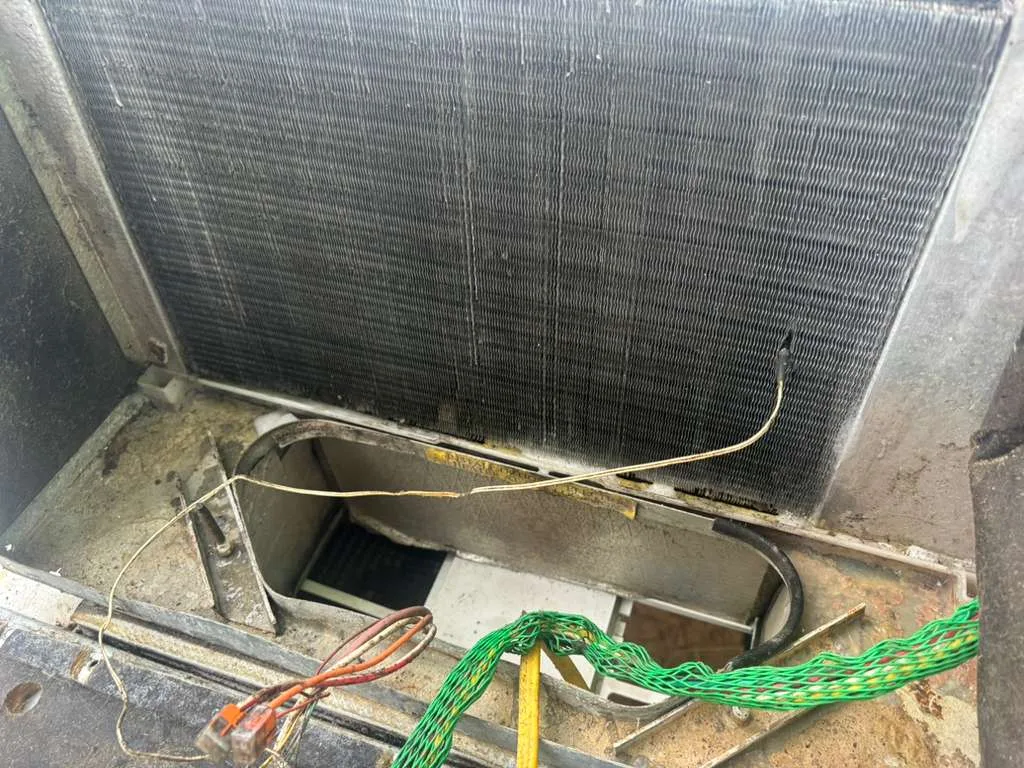
Check the return filter, confirm every supply vent is open, and then measure the difference between the air going into the unit and the air coming out. That last number is the one that separates a faulty unit from a healthy unit that has simply been beaten by the load, and it is the single most useful thing you can tell a technician.
What do you check before assuming it is broken?
The filter and the vents, because a starved evaporator produces exactly the symptom of a failing unit and costs nothing to fix.
The return grille inside pulls all the air the unit works on. A filter clogged with dust, pet hair or pollen chokes that, and a unit that cannot move air cannot move heat however healthy its compressor is.
Supply vents are the other half. Coaches often have vents closed off in rooms nobody uses, and closing too many raises the pressure the blower works against and reduces flow across the coil.
Both take a minute and both are things we frequently arrive to find. It is worth ruling them out before anything else, if only so the call is about the actual fault. It is also the cheapest possible outcome, which makes it worth two minutes of your afternoon.
Is it the unit, or is it the load?
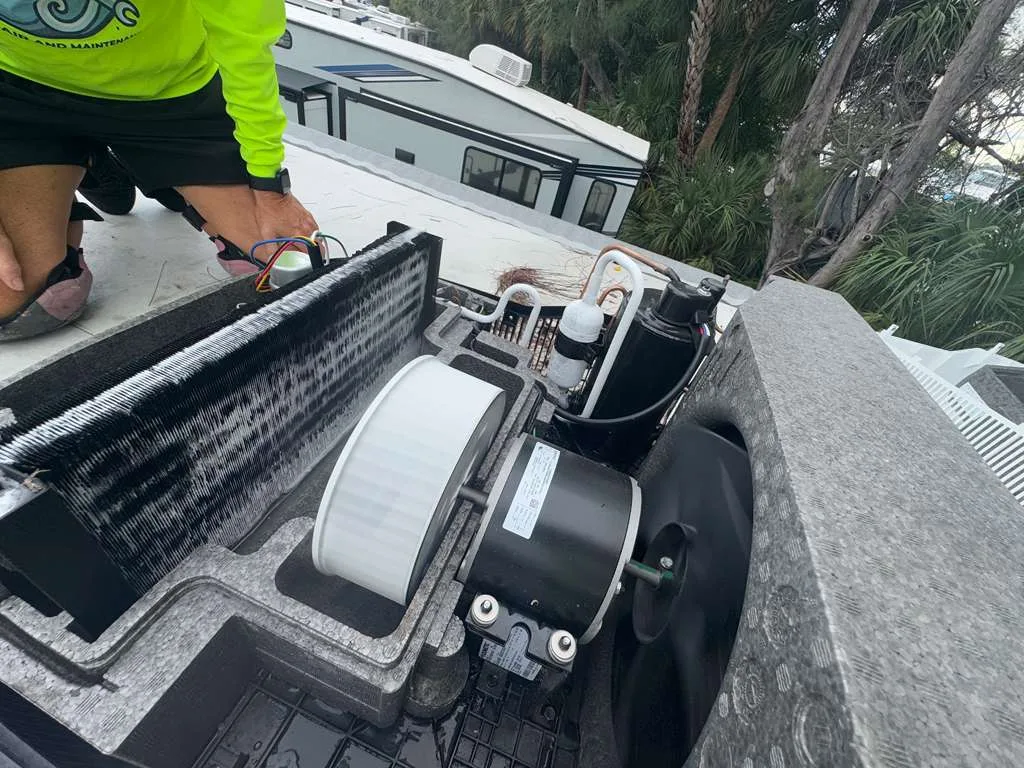
That is the real question in a Florida summer, and the answer is often the load rather than the unit.
A rooftop air conditioner is rated to remove a certain amount of heat per hour. It is not rated to reach a particular temperature. When the sun is on the roof, the outside air is in the nineties and the coach has thin walls and large windows, the heat arriving can exceed what the unit can remove.
Nothing is broken in that situation and no repair will fix it. What helps is shade, reflective window covers, keeping the door shut, and running the unit before the coach gets hot rather than after.
That is also why a unit that coped in April can seem to fail in July without anything changing inside it. Establishing which of the two you are dealing with is the whole point of the next section.
How do you measure whether it is actually working?
With a thermometer at the return grille and one at a supply vent, and the difference between them is the answer.
A healthy unit drops the air passing through it by a substantial margin. Measure at the return, measure at the nearest supply vent with the unit running steadily, and subtract. That number tells you whether the appliance is doing its job regardless of what the room feels like.
A good difference with a warm coach means the unit is fine and the load is winning. A poor difference means the unit genuinely is not cooling and the fault is inside it.
It costs nothing, it takes five minutes, and it turns an argument about how it feels into a measurement. Report that number when you call and the visit gets considerably shorter. It is the difference between a service call that starts with a diagnosis and one that starts with guesswork.
What does ice on the coil mean right now?
That airflow has been too low for too long, and the immediate move is to switch to fan only rather than to keep asking for cold.
Ice forms on the evaporator when not enough warm air passes over it to carry the cold away. It builds gradually, cooling gets steadily worse, and then stops entirely because the coil is now a block of ice with no airflow through it at all.
Running the fan alone melts it in half an hour or so. That is a diagnosis rather than a repair - it confirms restricted airflow and it will happen again unless the cause is found.
The usual causes are the filter and vents from the first section, a fan running slowly, or simply running on maximum cold continuously in very humid air, which Florida supplies free of charge.
Why does it trip the breaker only sometimes?
Because the compressor's starting surge is several times its running draw, and anything that raises that surge pushes it over.
Running along steadily, a rooftop unit draws modestly. Starting, it demands a brief spike, and that is the moment a pedestal breaker or a generator gives up. Which is why the trip happens at start-up and never in the middle of a cycle.
A weak start capacitor raises that surge, which is why intermittent tripping is often the first sign of the same part that later produces warm air. Low supply voltage does the same thing from the other direction.
A soft start device reduces the surge and is a common fix for coaches at marginal sites or on smaller generators. It also takes stress off the compressor every time it starts. So intermittent tripping is worth acting on rather than working around, because it is usually an early warning.
What makes a Florida afternoon different?
Humidity, which changes what the unit is actually being asked to do.
An air conditioner removes heat and water at the same time. In dry air most of its capacity goes into lowering the temperature. In Florida a large share goes into condensing moisture out of the air instead, so the same unit delivers less temperature drop for the same effort.
That is why a coach can feel clammy rather than hot, and why running the unit continuously rather than in short bursts often feels better - it keeps pulling moisture out instead of letting it back in between cycles.
It is also why the condenser coils on the roof matter so much here. A coil packed with pollen and road grime cannot reject the heat it has collected, and everything downstream of that gets worse.
What should you not do while you wait?
Do not keep cycling it, do not top up refrigerant, and do not run it on a supply you already suspect.
Repeated starts on a unit that is struggling are the hardest thing you can do to a compressor. If it is not cooling, switch it off and leave it off rather than trying every ten minutes.
These units are sealed systems and are not designed to be topped up. Anything sold as a quick refrigerant fix for a rooftop unit either does nothing or contaminates a system that then needs replacing rather than repairing.
And if the pedestal or generator is marginal, running the unit on it repeatedly does real damage. Low voltage at start-up is harder on a compressor than no voltage at all. All three of those turn a repairable fault into a replacement, which is a bad trade for a few hours of discomfort.
What will a technician want to know?
Four answers, and having them ready genuinely shortens the visit.
Does the fan run and is it only the cold that is missing. Is there any difference at all between return and supply air, and what is it. Has it been icing up. And what is it running on - shore power, and at what pedestal amperage, or a generator.
Those four separate a capacitor from a compressor from a supply problem before anyone opens the shroud, and the first of them is diagnostic on its own: a fan that runs with no cooling is the classic capacitor signature.
Our air conditioning service page explains what each of those turns into, and our electrical service covers the supply side. Writing those four down while you wait costs nothing and is genuinely the most useful thing you can do.
Questions owners ask when the AC stops cooling
Can I add refrigerant to my RV air conditioner?
No. Rooftop units are sealed and have no service ports for a reason. Products sold for this either do nothing or introduce sealant into a system that then cannot be repaired, only replaced. A unit genuinely low on refrigerant has a leak, and that is a replacement decision rather than a top-up.
How cold should the air coming out actually be?
Judge it as a difference rather than a number. A healthy unit drops the air passing through it substantially against what it is drawing in, and that gap is what tells you it is working. On a humid Florida afternoon the absolute temperature will look disappointing even on a perfectly good unit.
Is it worth fitting a second air conditioner?
On a larger coach that has never quite coped in summer, often yes, and it is a planning decision rather than a repair. What it needs is a second roof opening and the electrical capacity to run both, which usually means a fifty-amp service or an energy management system.
Why does it cool better at night?
Because the load has dropped. No sun on the roof, cooler outside air and lower humidity all mean the same unit removes more of what is left. A unit that cools well overnight and struggles at three in the afternoon is behaving normally rather than intermittently failing.
Does closing vents in unused rooms help?
It seems like it should and it usually makes things worse. Closing too many raises the pressure the blower works against, drops airflow across the coil, and is one of the more common causes of a unit that ices up. Leave them open.
How long does a rooftop unit last in Florida?
Fewer years than the same unit further north, because it accumulates run hours far faster and salt air works on the coil and the connections. Cleaning the coils annually makes more difference to that number than the brand does.
Sources
- Dometic Penguin II - service manual - Manufacturer expectations for airflow and the temperature difference across the unit.
- Dometic - rooftop air conditioner documentation - Installation and service documentation for the common rooftop units.
- Airxcel - RV climate brands - Documentation for the Coleman-Mach and related units and their controls.
- OSHA - electrical hazards - Background on why a marginal supply is a hazard as well as a performance problem.